Zeuxis: The Oranges of Seville
For The Oranges of Seville, this month’s invitational exhibition at Bowery Gallery, the still life artists of Zeuxis and their guests were asked to respond to Francesco de Zurbarán’s 1633 painting Still Life with Lemons, Oranges, and a Rose, a masterwork of the genre. At once a striking example of the bodegon tradition popular in 17th century Spanish painting, (featuring fruits, vegetables, sweets, and other humble pantry items) and a religious allegory (invoking either the Holy Trinity or the Virgin Mary, depending upon one’s interpretation), Zurbarán’s painting offers both clarity and mystery, sharp observation and poetic meditation.

Francesco de Zurbarán, Still Life With Lemons, Oranges, and a Rose, 1633
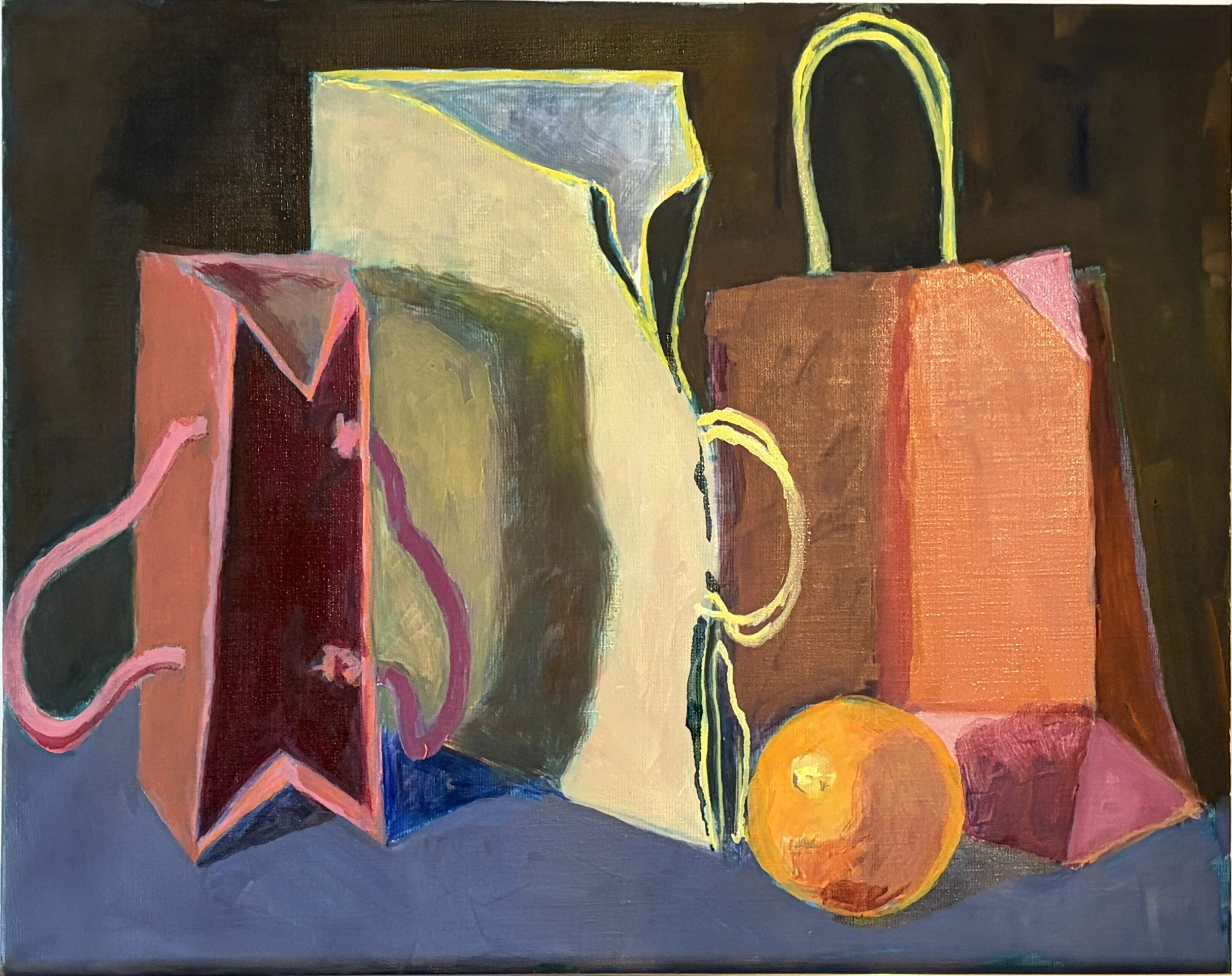
Phyllis Floyd, Bags with Oranges
Zeuxis, an association of still life painters, was founded by Phyllis Floyd and several of her painter colleagues in her New York City loft in 1994. Floyd recalls: “In the 1990s sometime I began to assess the condition of still life painting in the climate of the post modernist art world. Prospects looked bleak. It was time to rally my forces, and I drew in still life painters one by one with the object of mounting group exhibitions. Rita Baragona offered us space at Blair Academy for the first show. This was followed by one at Kohn, Pederson, Fox in the Steinway Building on 57th Street. The needed assistance materialized somehow with the usual complaining and argument such cooperative projects engender. But the large opening was exhilarating, and Zeuxis was on its way.”
I recently spoke with Floyd about Zeuxis and The Oranges of Seville.
NG—Phyllis, since you founded Zeuxis in 1994 you’ve mounted exhibitions in over 50 galleries, in New York and around the US. You must have experienced some significant changes in the art world in that time. Do you feel that still life painting, and observational painting in general, have experience a resurgence over those 30 odd years? And What changes have you noticed in the gallery environment in New York?
PF—Yes, it's a new art world. Even though college art departments have cut number of courses taught, there are more and more painters. In the art world since the 90's, there is now a wide acceptance of figurative art. But it's increasingly difficult to find venues that will host our exhibitions--in New York, rents are rising, and commercial galleries have to show expensive work in order to function. Throughout the country, these days there are next to no opportunities for an association such as Zeuxis to find exhibition space--college budgets have been cut. We are gratified that Bowery Gallery accepted our show.
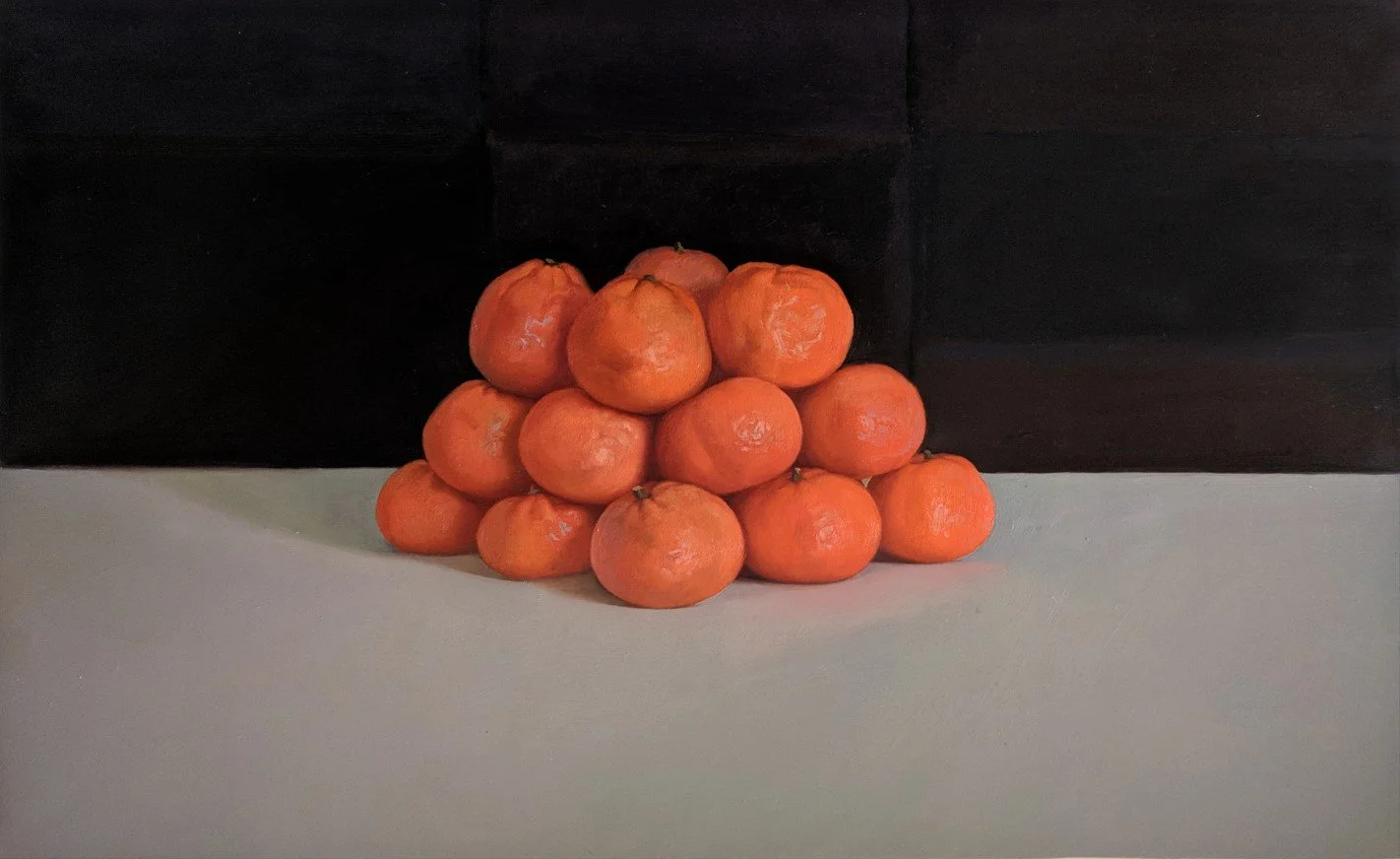
Emil Robinson, Orange Pyramid
NG—Most Zeuxis group shows involve a theme of some kind. How did you come to choose that approach? Are there particular themes from past years that stand out to you in retrospect?
PF—We ask the artists of Zeuxis to come up with themes. We planned themes to enhance the exhibitions’ coherence and increase interest. (Some of the Zeuxis artists don’t like the restriction of themes, but others have said they enjoy the challenge.) I think my favorite theme was a dish towel, for our 2010 exhibition The Common Object. It had an especially long run at Maryland Institute College of Art beginning in 2011, and the gallery director arranged a series of talks featuring Zeuxis artists and guests. Elizabeth Geiger stood before her large painting and spoke so movingly that everyone was quiet for fear of missing a word. Temma Bell did a dance as she talked about her piece, evidence that she and the painting were one.
NG- What is it about Zurbaran and Spanish bodegon that appealed to you for this year’s theme?
PF- About 18 months ago, a large catalog of a Spanish Still Life Exhibition in Europe was lying on my table. I began reading and at the same time thinking of Zeuxis. I impulsively put out Spanish painting for consideration. The thought was that it would be challenging and certainly no other organizer of shows would offer a duplicate.
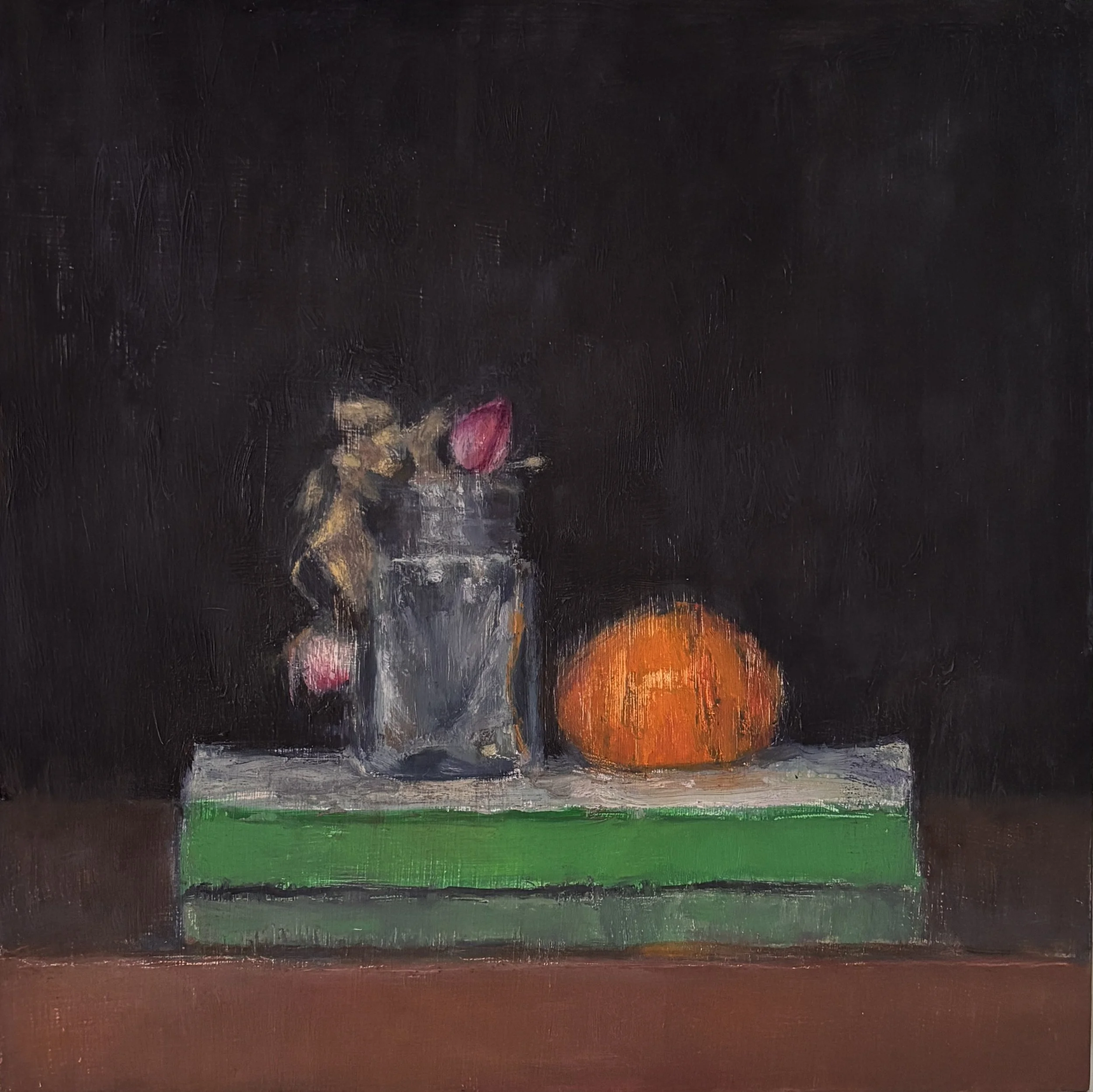
Eileen Mooney, Clementine, Dried Rosebud, and Franny and Zooey
NG- Looking at the work included in this year’s show, I’m struck by the variety of responses to the prompt. Some, like Emil Robinson, Eileen Mooney, and Nancy McCarthy, seem to capture the feeling of spaciousness and quiet contemplation that are so much a part of Zurbaran’s painting. Andrew Marcus’ Dark Still Life reflects Zurbarán’s ability to hold each component of his still life in tension, like so many individual portraits separated by dark negative space.
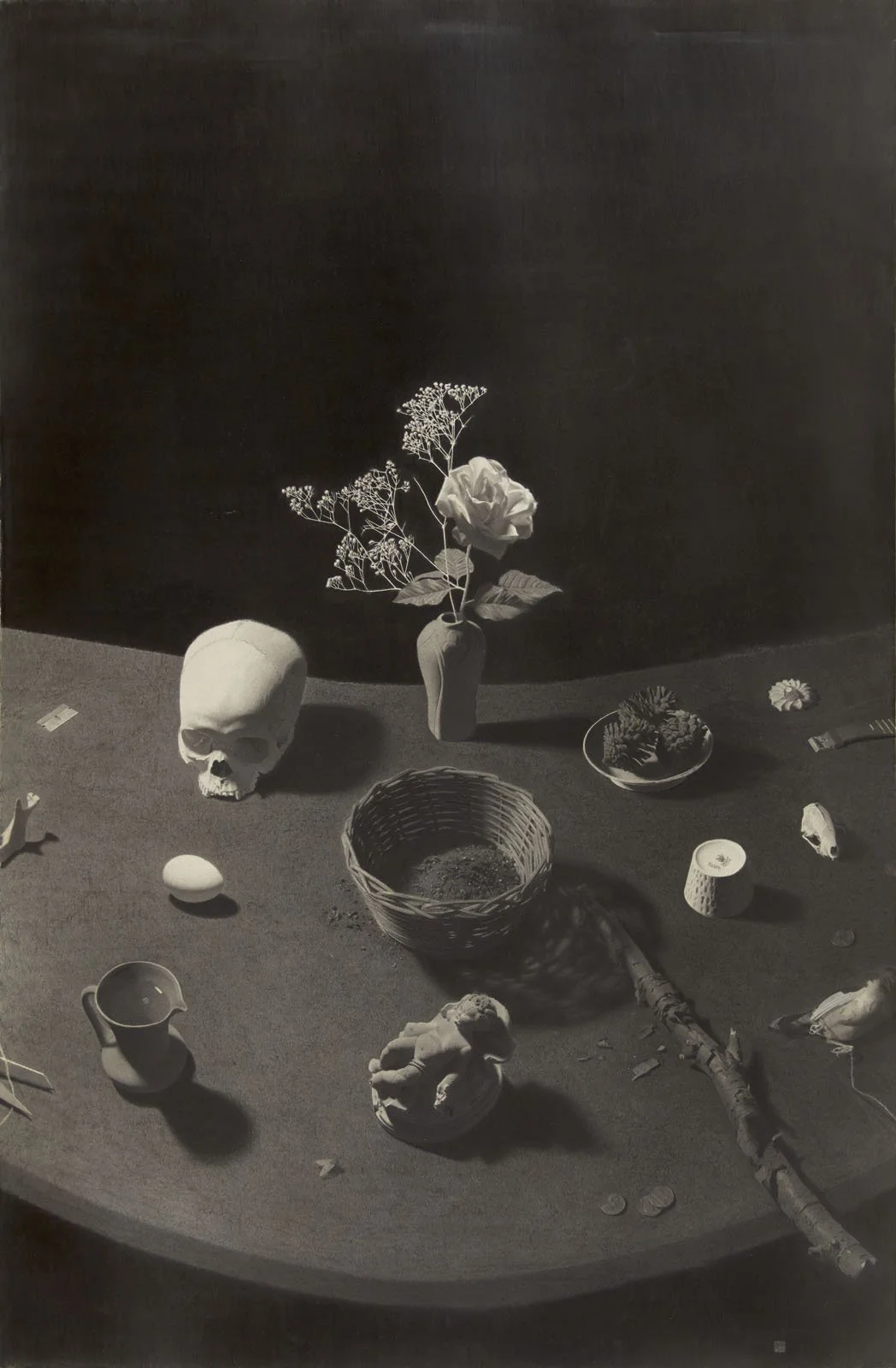
Andrew Marcus, Dark Still Life
Others, such as Temma Bell’s and Patrick Neal’s, provide more of a sense of teeming abundance while recalling the humble origins of the bodegon.
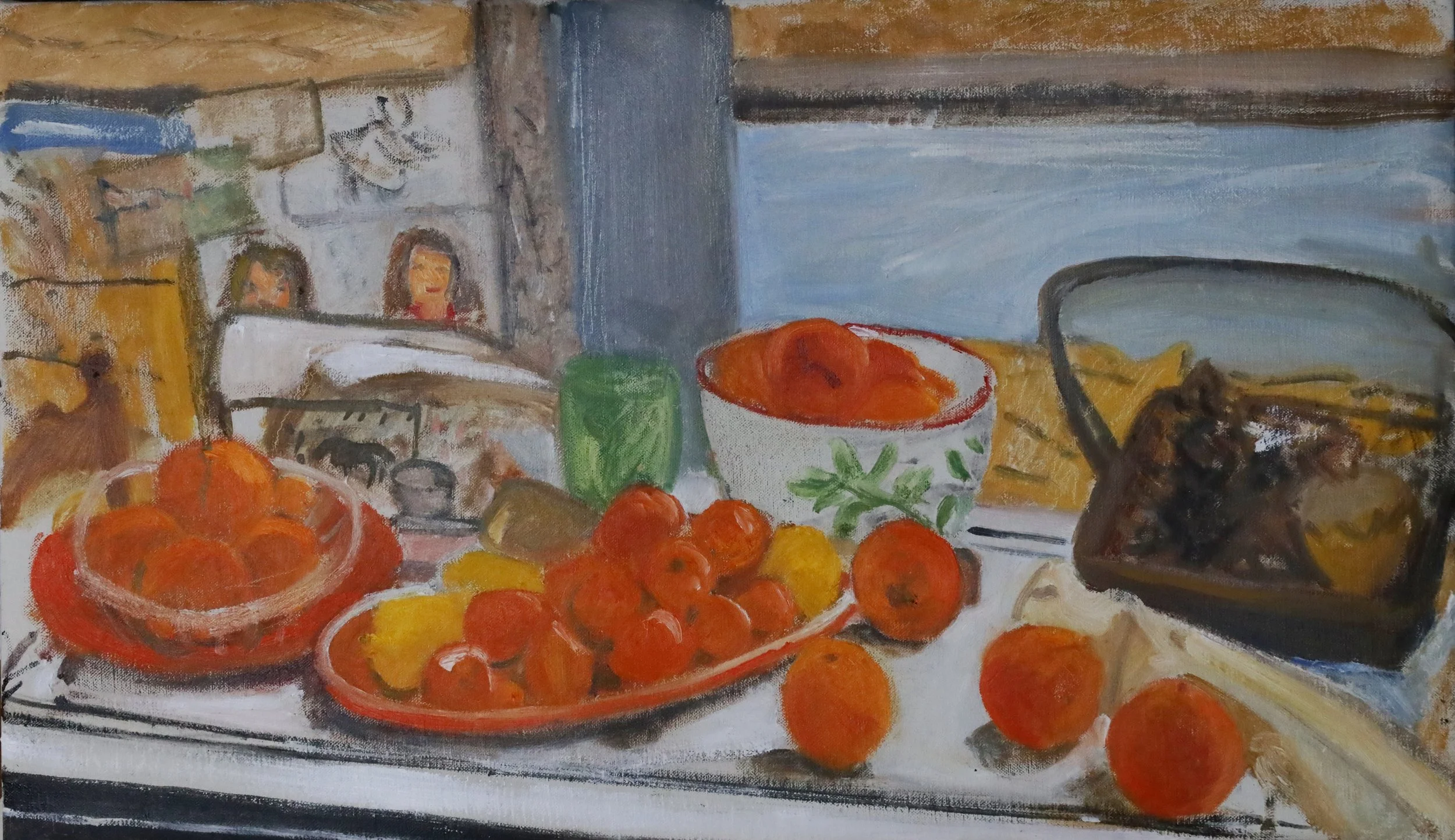
Temma Bell, Orange Still Life 2
Other works provide more idiosyncratic responses to the theme. In her painting Late Night at the Dining Table (Spanish Palette), on the other hand, Carol Rabe chooses to engage not with the literal subject of Zurbarân’s painting, but rather with his somber palette and contemplative mood. The role of bright citrus fruit is played by a glowing lampshade silhouetted against dark walls. Neil Callendar responds to Zurbarán’s palette as well, and his tent in shades of orange, lemon, and rose frames a darkness as deep and mysterious as Zurbarán’s. Daniel Dallman’s simple cup of tea recalls both the domestic subjects of the bodegon tradition and Zurbarán’s cup of water. And in yet another interpretation, Matt Klos offers a work drenched in Iberian sun, painted on site in Tavira, a Portuguese town located not far from Seville.
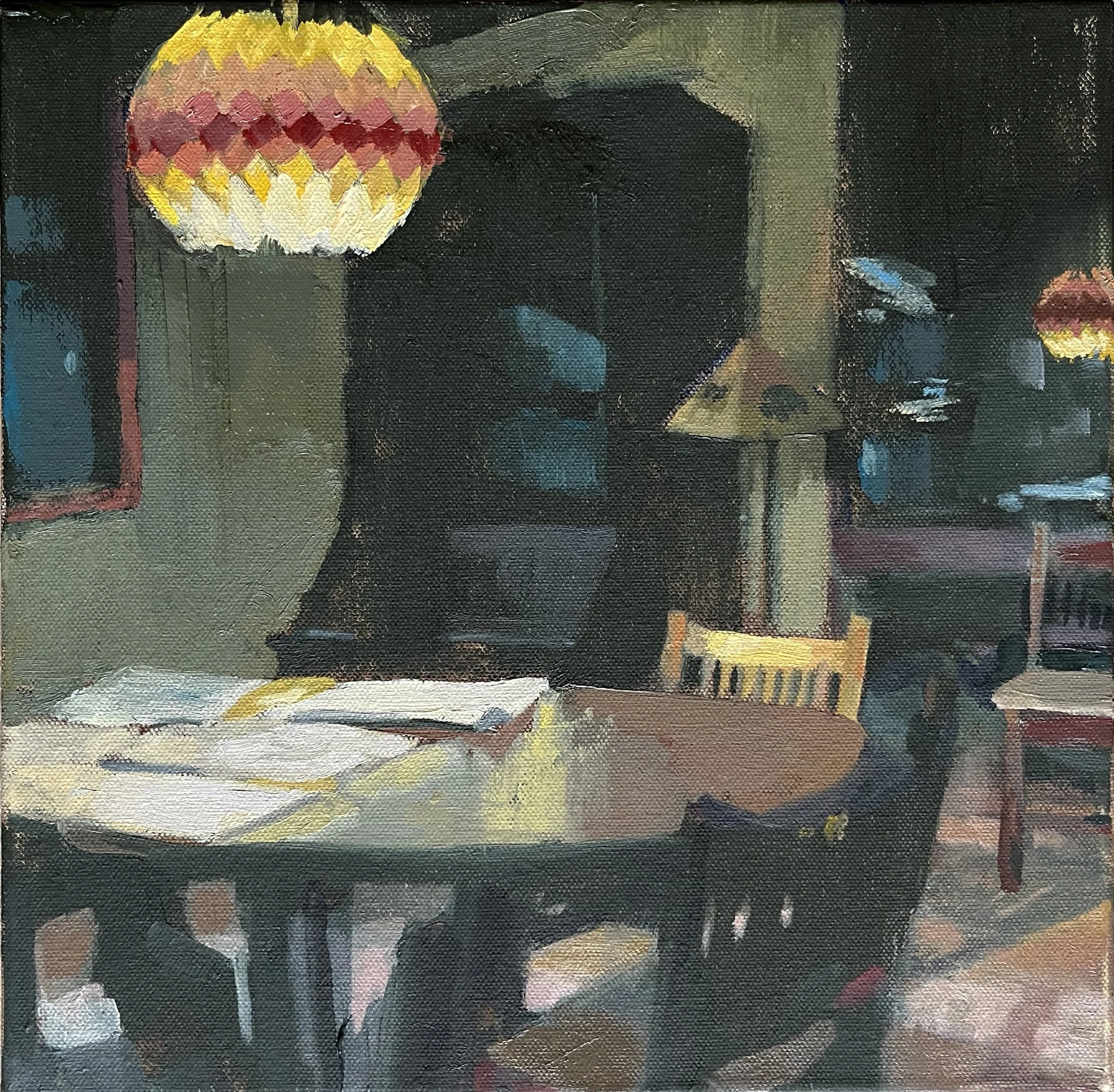
Carol Rabe, Late Night at the Dining Table (Spanish Palette)
From my own experience, I could say that this was a challenging theme. At one point I painted a lot of of tabletop still lifes, but in the past several years, I’ve gravitated toward works with a much shallower sense of space, and an intense focus on a single object, usually a vase of flowers. But I love the sense of vast spaciousness in Zurbarán’s painting and tried to respond to that— not so successfully, I fear.
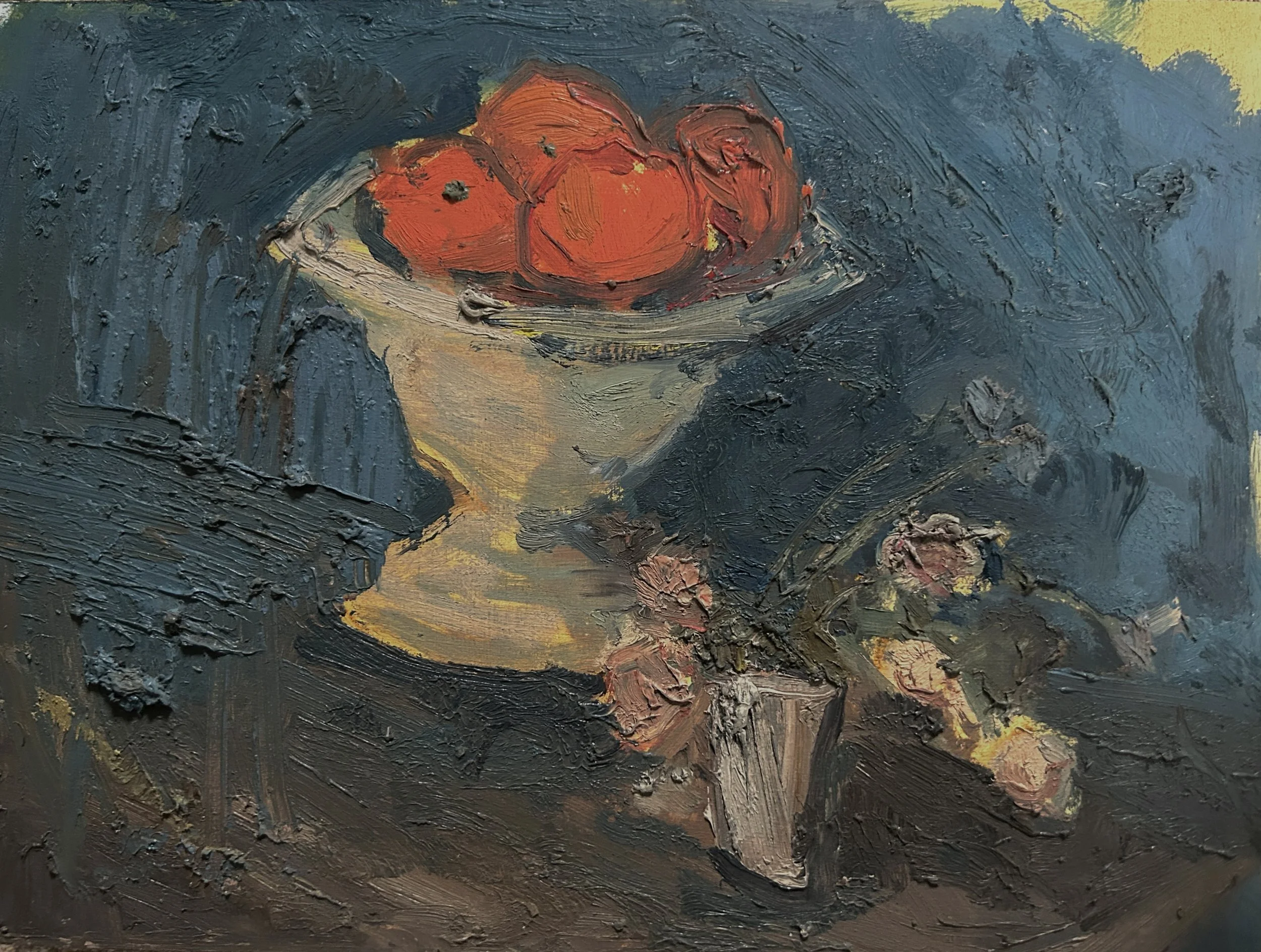
Nancy Granda, Citrus and Rose in Dark Studio
Can you say something about your own process in responding to this year’s theme, Phyllis?
PF— In general, I favor paintings done for the show, rather than paintings that are just there hiding on somebody's shelf. I did about 10 orange watercolors plus 3 oils in preparation. Finally, I closed my eyes and took one to the framer. I was determined to have a dark background. First the orange was floating above, but I couldn't make that work. In the one on view, I tried to reconcile formal problems such as curves vs rectilinear and 2 kinds of reds.
NG— Finally, what’s next for Zeuxis?
PF— In 2023 Zeuxis published CONVERSATIONS, a compilation of artist interviews featuring over 60 contemporary still life painters. Since then, Zeuxis has continued to post new artist conversation on Zeuxis.us ; we’re hoping another book might be in the works. And we are preparing to hold an exhibition of watercolors at THERE Gallery in the coming months.
CONVERSATIONS is available for purchase at Zeuxis.us ; copies will also be available at Bowery Gallery for the duration of The Oranges of Seville.