
Daphne Minkoff- We Carry It With Us
John: Hi, Daphne. Many thanks for engaging in this written conversation about your recent work. I'm looking forward very much to your upcoming show!

“Wild Blind Earth”
Except for a collage in a Bowery group show some years ago, I've never seen your work in the flesh. But judging from digital images, it should be a compelling show. To me the paintings and collages suggest an urgent need to witness, but also a certain detachment. I feel the artist's affection for the subject matter, but also a distancing – a strong sense of loss and displacement. The images are nostalgic, but not the least sentimental, while the titles ("Sinking Feeling," "Ripples of Consequence") hint at an almost ominous backstory. Am I on to something here?
Daphne: It’s always a bit of a thrill when someone who isn’t very familiar with my work sees something in it that feels true. So yes, I think you’re definitely on to something, especially your description of an “urgent need to witness.”
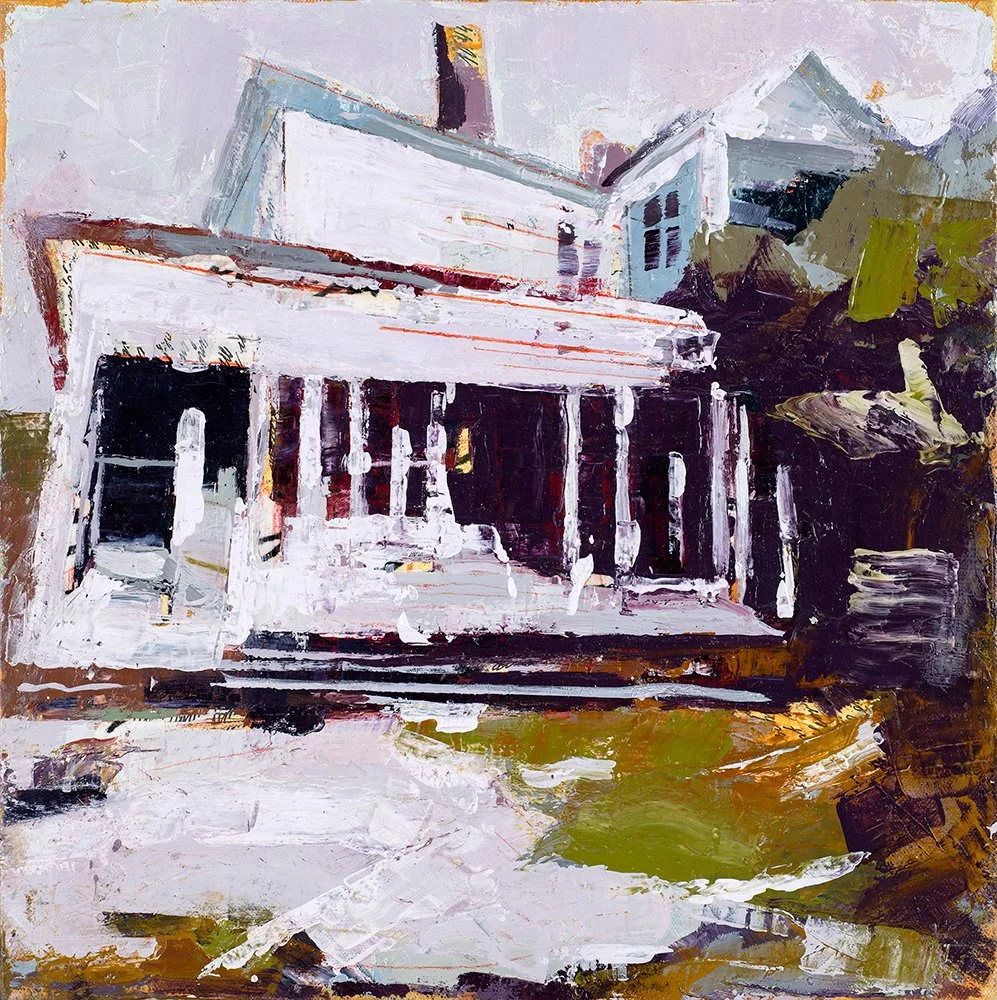
For years I’ve been painting boarded-up houses and buildings, mostly in Seattle, as a way of witnessing a landscape that’s constantly changing. I’ve always been drawn to places that feel overlooked or on the verge of disappearing. Photography has become an extension of drawing for me. I photograph places that stop me in my tracks, but I don’t paint them right away. Sometimes months or even years pass before I return to those images. That distance gives memory room to reshape what I saw, so by the time I’m painting, I’m responding as much to the emotional experience of the place as to the place itself.
“Thinking of Home”
“Sum of My Misfortune”
This body of work isn’t about October 7, but it did begin in its aftermath. I was visiting Montgomery, Alabama, just a week later, carrying a profound sense of grief and disorientation. I wasn’t looking for these buildings, but they seemed to find me. I’d photographed boarded-up structures for years, but these felt different. Standing in front of them, I felt an almost palpable sense of sadness and presence, as though they were holding something beyond their physical history. I don’t think I would have experienced them that way had I not been carrying what I was carrying.
That experience made me realize I wasn’t just responding to the place itself. I was bringing my own emotional landscape with me. It made me think about how the things we carry—grief, memory, history, loss—shape the way we move through the world and experience the places around us.
So I think the tension you describe—the affection alongside the distance, the nostalgia without sentimentality—comes from that space. These paintings aren’t really about abandoned buildings. They’re about how our inner lives shape the way we experience place, and how place, in turn, helps us understand ourselves.
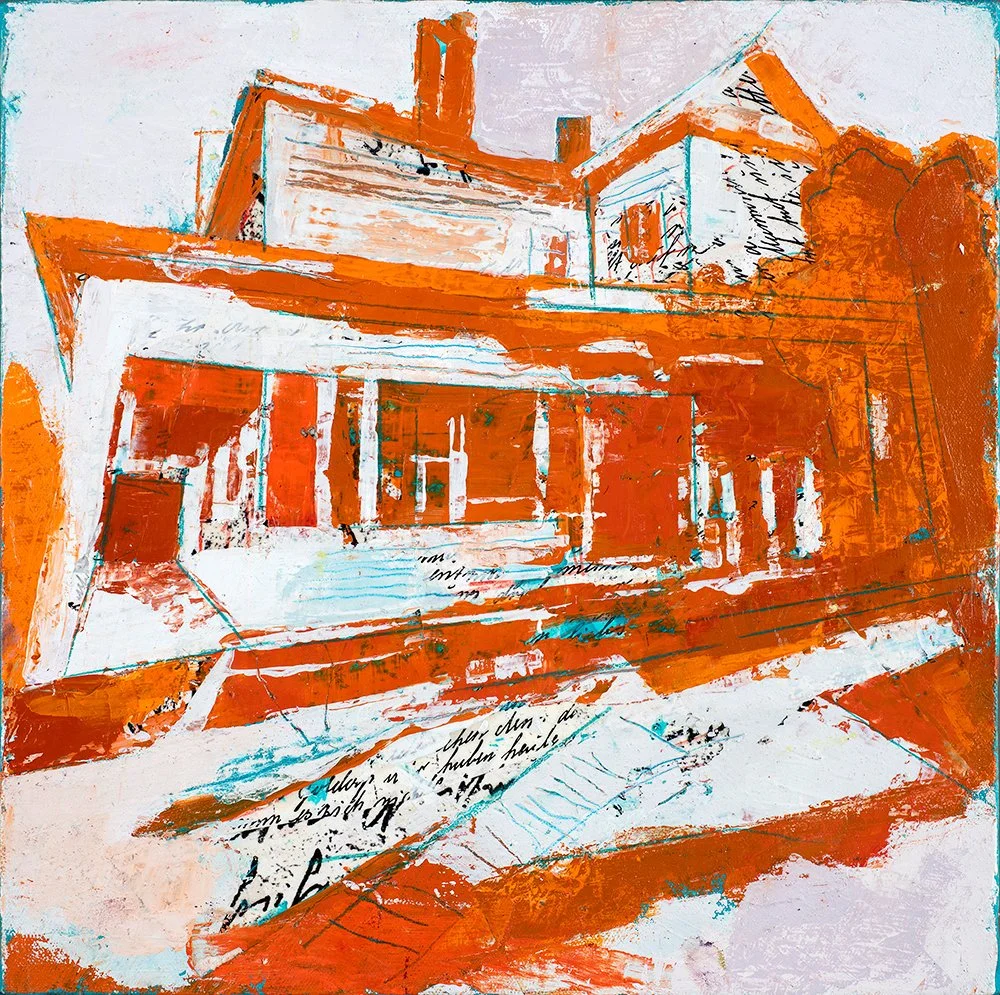
John: It's fascinating to me how in the canvases the buildings are essentially solid – they're intact, and conform to basic rules of perspective and the effects of gravity and natural light – while the collaged texts are the opposite: half obliterated, and oriented at various, seemingly random angles.
Daphne: I love that you picked up on that tension, because it’s something I was very conscious of while making the work.

“Permanence is an Illusion”
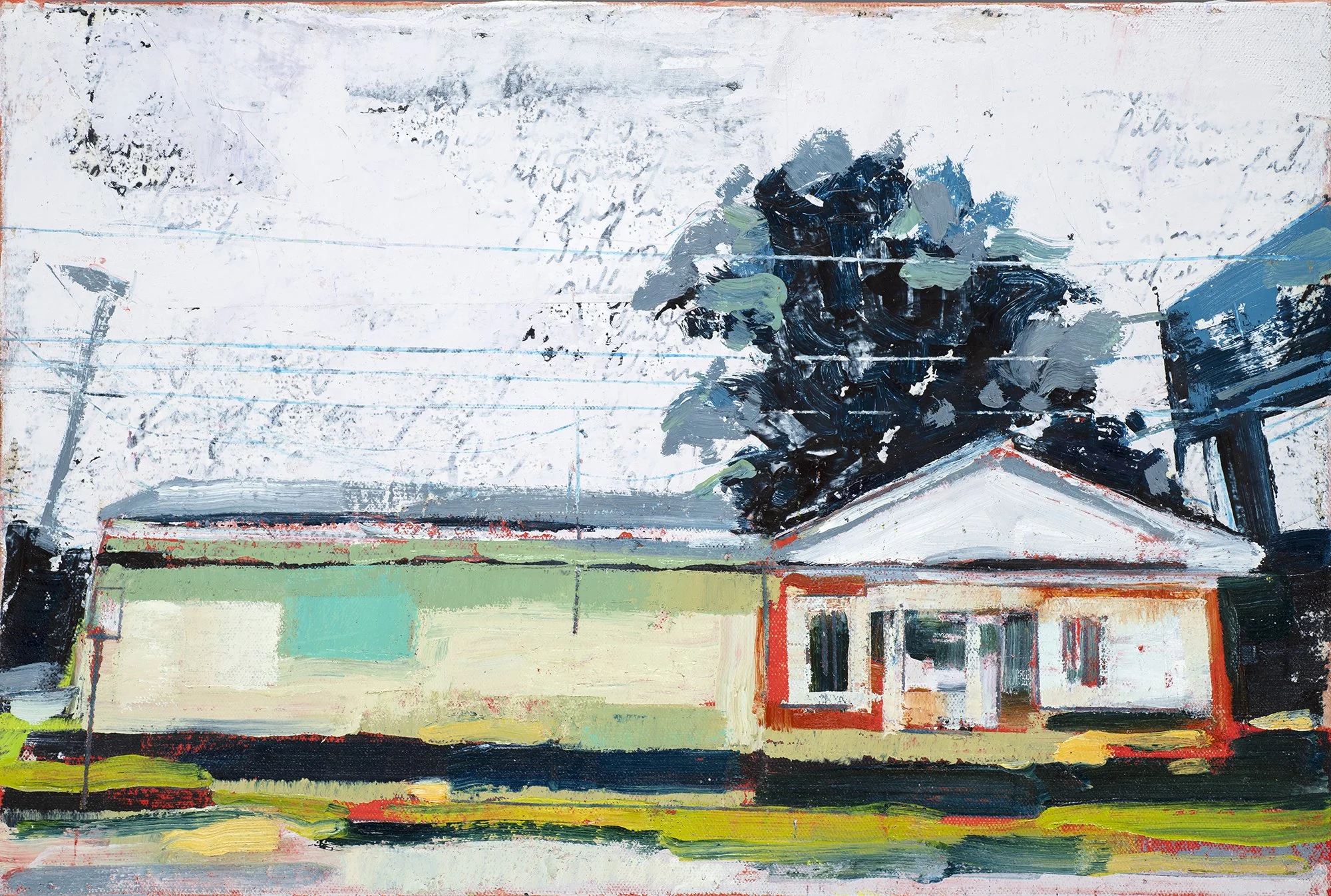
The collaged layer comes from copies of my maternal grandfather’s last correspondence with his family before he was killed on the Russian front during World War II. I enlarged the letters at different scales, then tore them apart and used those fragments as both structure and an under layer-sometimes to build out the forms of the buildings, sometimes to create the structure of the foreground or background. I then painted over them, but intentionally left parts of the handwriting visible so it would function almost like a kind of white noise running through the paintings.
I was interested in introducing something deeply personal, but also partially obscured-something that carries emotional weight without becoming illustrative or legible in a narrative way. In a strange way, it parallels how I approach the houses themselves. I don’t know the people who lived in them, just as I didn’t know my grandfather, but there’s still a felt connection to their presence and their absence.

“Return to This Place”
Over time, the writing became less about content and more about traces or remnants. It also allowed for a kind of friction between order and disruption: the buildings hold a kind of structural clarity and perspective, while the fragments of text underneath are broken and unstable.
I’m interested in that push and pull like a continual negotiation between construction and collapse. The collage lets that tension exist materially inside the paintings, rather than just as a subject.
John: I like the notion of push and pull. Perhaps it’s like saying the collages aren’t just escapist fantasies; they’re investigations that make certain demands on the viewer.
Daphne: Absolutely. I hope the work invites curiosity more than it provides answers. I’m less interested in the viewer arriving at my meaning than in creating a space where they begin asking their own questions.
“They Never Came Back”
The fragments of letters have a kind of texture for me, both visually and emotionally. Even if the writing is no longer legible, I hope it carries the sense of voices in the background. Then the viewer brings their own experiences to the work: ideas about home, abandonment, nostalgia, or whatever associations the paintings awaken for them. That’s the exchange that interests me.
I’m curious, John, before you knew the source of the collage, how did the writing land on you, both visually and emotionally?
John: Before learning the background of the writings, I guess I felt the impact of the words in a more general way – less about personal history, and more about the relationship of words to painting/collage. The painted/collaged structures seemed sturdy, and the words were glimpses of verbal thinking that embroidered visual experience. I think most of the time we tend to absorb our surroundings in verbally expressible chunks, but here it’s great to see words in these collages paying second fiddle (an important second fiddle!) to the visual expressions of color and form. But learning the story behind the texts helps close the circle of context – "so that's why the artist was driven to do this or that."
“Whispers”
“Whispers II”
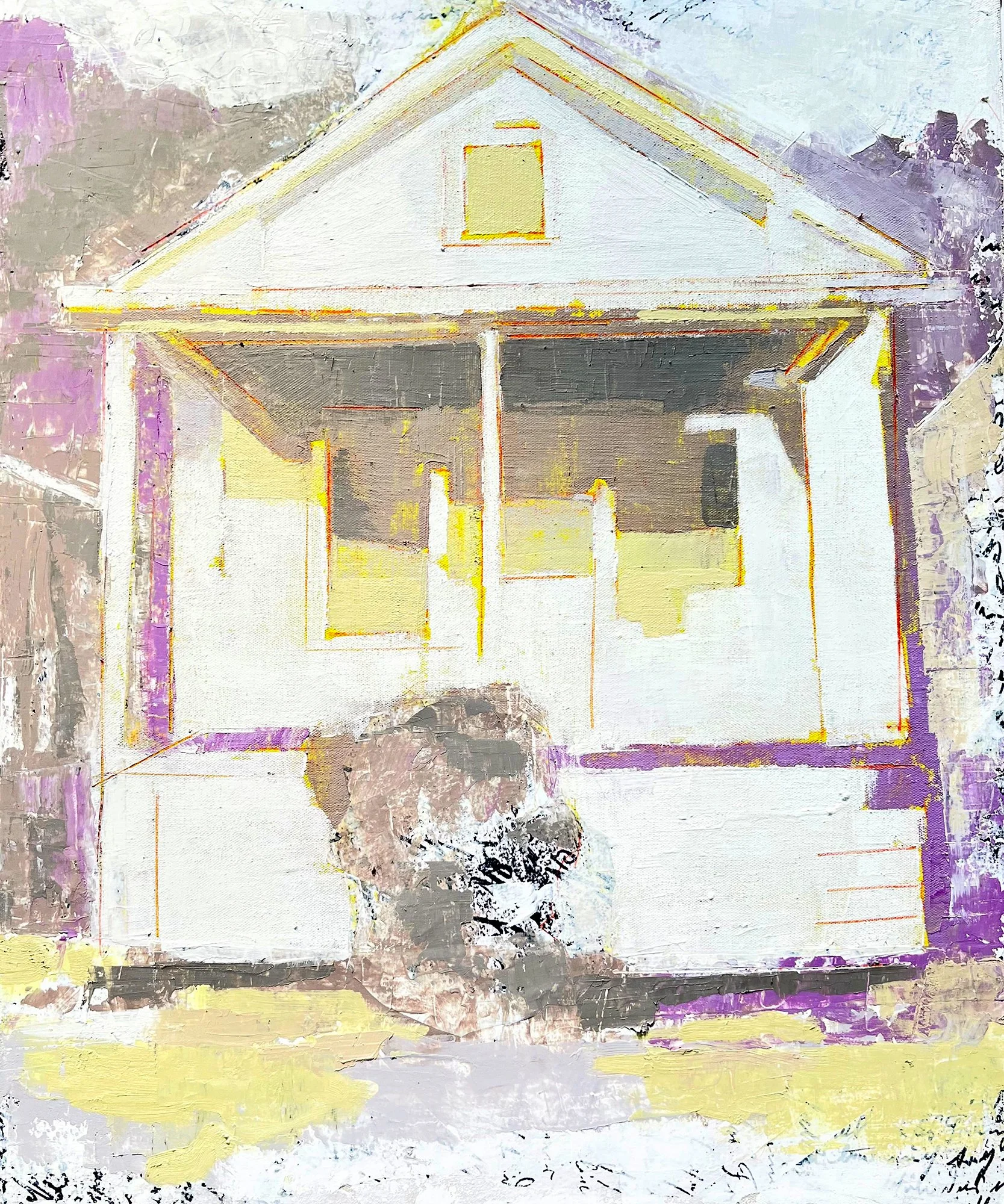
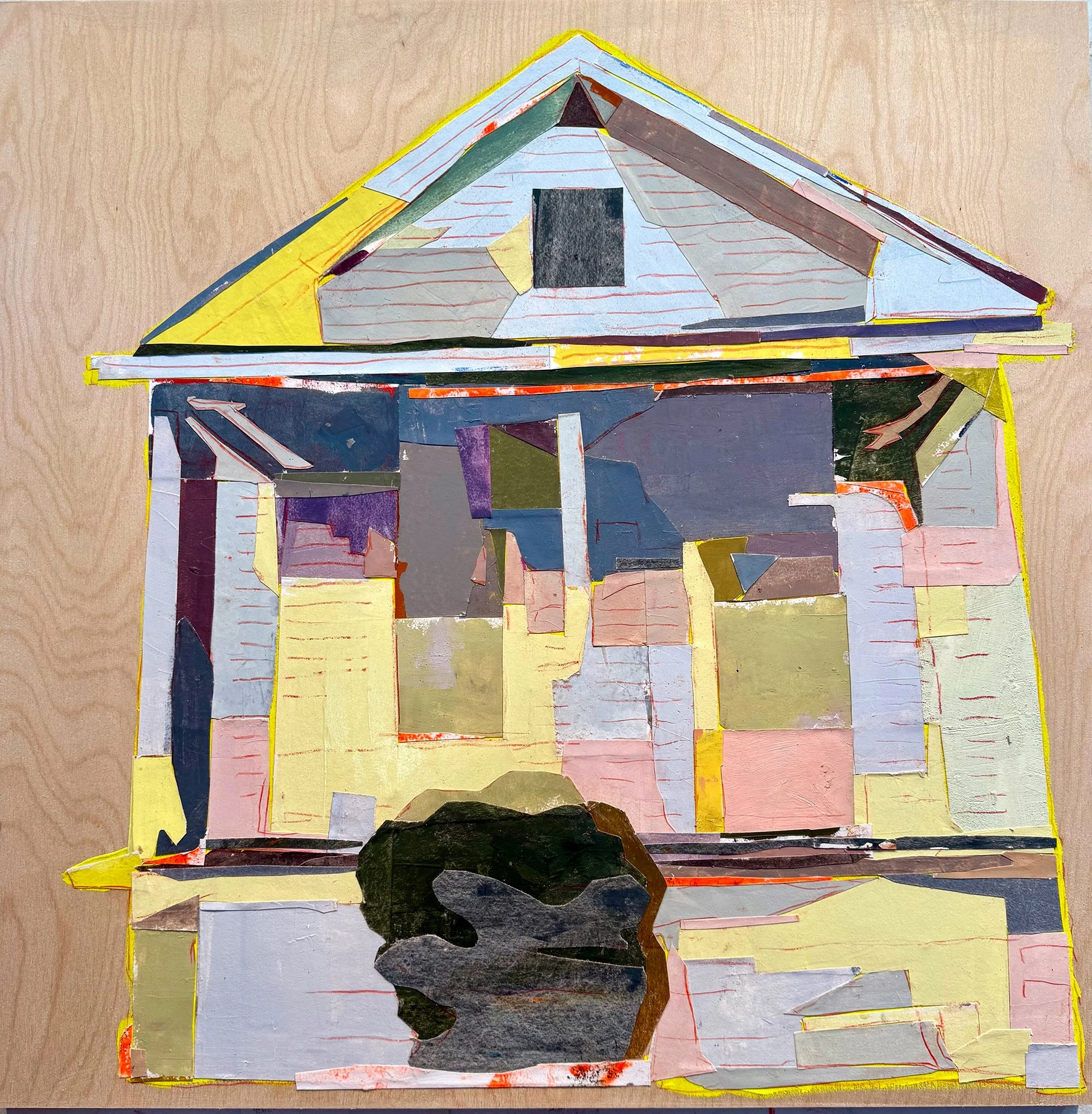
Can I ask about the differences between the canvases and the works on wood panels? These feel quite different. The images on the panels seem more abstracted, their colors heightened and less atmospheric, emphasizing surface pattern rather than a naturalistic integration of subject and surroundings. They also exploit the woodgrain in playful ways.
Daphne: Yes, they’re part of the same body of work, but they developed as a response to the paintings rather than alongside them.
For years I’ve had a habit of using leftover paint at the end of a studio session to make painted papers. I hate wasting paint, so over time I’ve accumulated quite a collection. The collages grew out of that material. I began cutting and assembling the painted papers to explore the value relationships and structural elements I was seeing in the paintings.
In a way, the process feels like that game of telephone we would play as kids-sitting in a circle, whispering one thing into the ear of the person next to you until it reaches the last person. The end result may contain a word or two of the original phrase, but the end result is something very different. This work starts with a photograph, which becomes a painting, which then becomes a collage. With each translation, the image moves further away from its source and becomes something more distilled. By the time I get to the collages, I’m less interested in describing a specific place and more interested in exploring shape, value, rhythm, and structure.

“Return To This Place”

“Wild Blind Earth II”
You’re absolutely right that they’re more playful. At some point I decided to eliminate the foreground and background altogether and focus almost exclusively on the houses themselves. Once isolated, they began to feel less like buildings and more like portraits. I also became interested in the relationship between the collaged forms and the wood panel beneath them. The wood grain felt strangely self-referential of the material the houses themselves are made from and I enjoyed letting that become part of the image.
Looking back, I think there’s also something emotionally revealing in the way they’re constructed. They’re made from hundreds of hand-painted, hand-cut fragments that are pieced together into a coherent whole. There’s a fragility to that process, but also a surprising resilience. Everything is held together by glue, literally and figuratively. I hadn’t fully articulated it while I was making them, but I think the collages became a way of thinking about how things can be both fragile and durable at the same time and how brokenness and wholeness aren’t necessarily opposites.
John: Thanks, Daphne. I love the idea of the fragile being durable. I’m looking forward to seeing it soon, in person!