Temma Bell: Then and Now
Eileen: Thank you so much, Temma, for engaging in this written conversation with me. I am so fascinated by your life–particularly as I am also a mother who is also a painter. Growing up with two painters for parents must have truly set you up for a life of artmaking. I have long been a fan of your mother’s work, and I love seeing all of the tender sketches of you reading in your youth. That must have somehow allowed you to consider the possibility of being a painter who is also a mother in a way that might be a lot harder for other painters who do not have such an intimate experience with navigating both. I wonder how those formative years informed how you navigated your painting practice while also having four children. Can you speak about the integration of your family life into your painting life, and vice versa?
Temma: I am not quite sure how to answer this. Growing up an only child of two painters, it just all seemed very natural. I went to the High School of Music and Art because it was supposedly a good school, my father gave me some crits for my entrance portfolio and one of my self portraits he felt I was being too fussy with the mouth and drew a straight line. I was not pleased. lol Painting seemed a very natural thing to do but when I applied for college I thought I would major in French literature. Now I am not sure which summer after going to either Aspen or Norfolk, Connecticut where my father was doing their summer programs that I decided I wanted to keep on painting and was able to transfer to Indiana University and from there to the Philadelphia College of Art where I spent one year and then went to Paris and joined my friend the painter, Sue Daykin. I went to Iceland that summer and my friend, the painter Suzanne Gilliard, and I joined Sue to share an apartment near Montmartre, to paint and visit museums in Europe. Then I came back and graduated from PCA.

Temma Bell, Self Portrait, Oil on Canvas, 37" x 26", ca1970
As for painting and having children, I most certainly had a good example. My parents never let me feel a burden, and they were homebodies, basically painting all day with pauses for coffee or tea and supper–which my mother made, usually. It all seemed to work very well. So I never thought there would be a problem painting and having kids.
Bowery Gallery has provided a place for me to show all these years that I have been painting and having kids and living on a farm with a potter who had an agricultural education, but went into pottery, which his sisters were in, and when we moved to the states, reverted to farming.
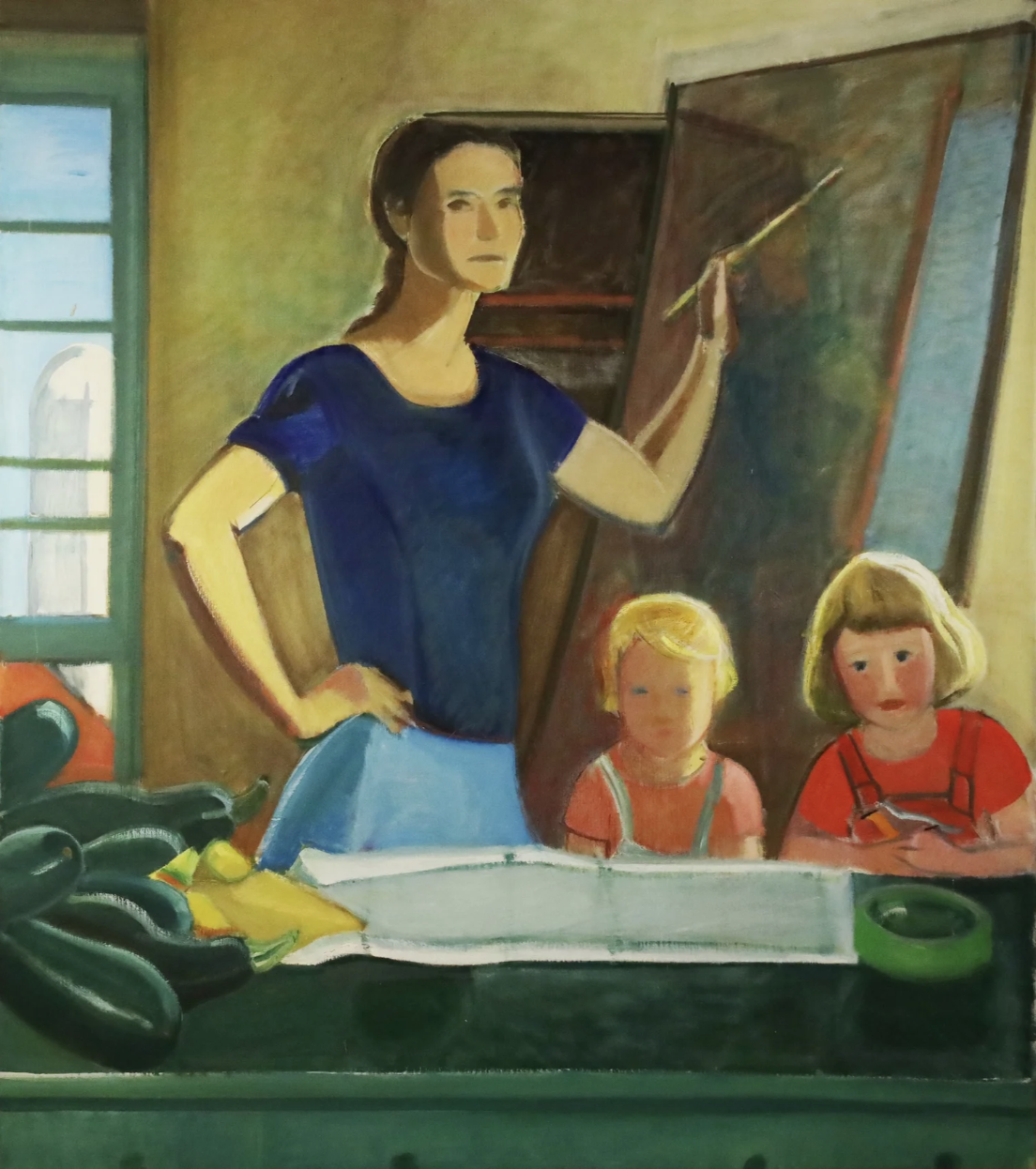
Temma Bell, Self Portrait with Ulla and Melkorka, Oil on Canvas, 52" x 46", 1983
Not much time for furthering a career. My mother had a show back in the early fifties in, I think, the oldest co-op in the city, The Jane Street Gallery. My father had gotten into the Hansa Gallery, and after that, was always in a gallery. My mother, however, did not have a gallery until she joined the Robert Schoelkopf Gallery where my father was, as well. Motherhood didn’t stop her from painting and it hasn’t stopped me, either.
Eileen: Who are the artists that you looked at most in your earlier years? And who do you look at now?
Temma: Chardin, Fayoum, Matisse, Velazquez, Bonnard, and I love Breughal. The list could go on and on. At this point, I don’t spend as much time looking at paintings. My time is spent either painting or spending time with family and grandchildren. I went to a lot of museums and galleries as a kid with my parents and was always amazed that my father knew who all the painters were. They were all just paintings to me–not in a bad way, but they all somehow belonged together almost as a family. I don’t quite know how to express it but they were just paintings that were fun to look at.
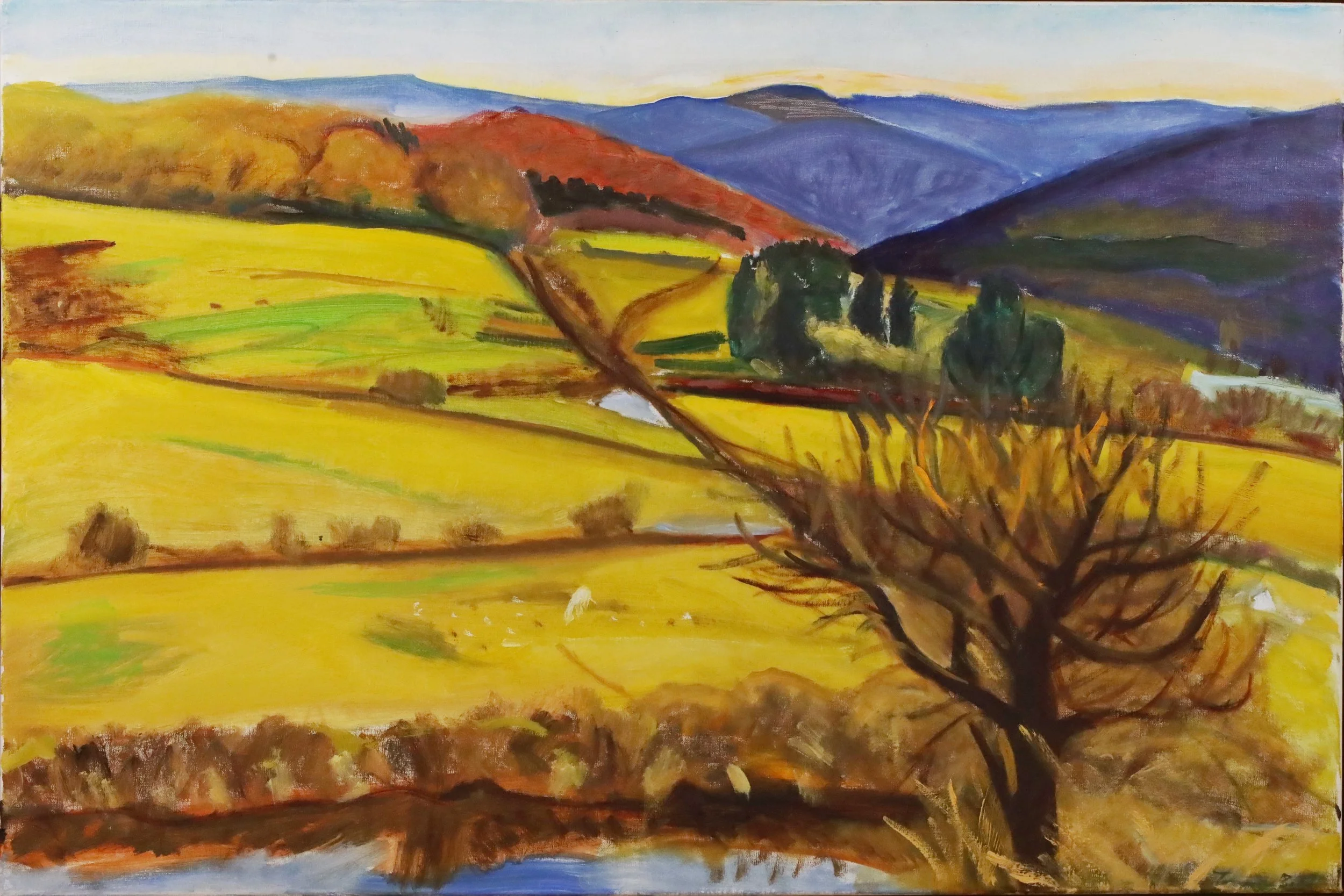
Temma Bell, Delhi Landscape, Oil on Canvas, 24" x 36", 2013
Eileen: How did it come to be that your daughter, Ulla Kjarval, is curating this show? I can imagine that you two had a lot of conversation about what to include, and I wonder if her approach/choices surprised you at all. I can only imagine that if my daughter was curating a show for me, I would be going crazy about what she would choose to include, how she would juxtapose the works, etc., but I also think that her decisions would be incredibly insightful. Can you share a little about what it felt like to have your daughter curate your show?
Temma: Ulla has grown up looking at art and is, herself, an artist. She has a very good eye and it was fun seeing what she picked out. She had a definite feeling for what she wanted to show. The one thing we forgot (or rather, I forgot) to bring were three long Esja paintings. Besides many trips to Iceland to see my grandmother and relatives, I ended up marrying an Icelandic potter. We lived in Iceland for 5 years and I would come back to show at the Bowery, which I had joined in 1970 a year after it was founded.
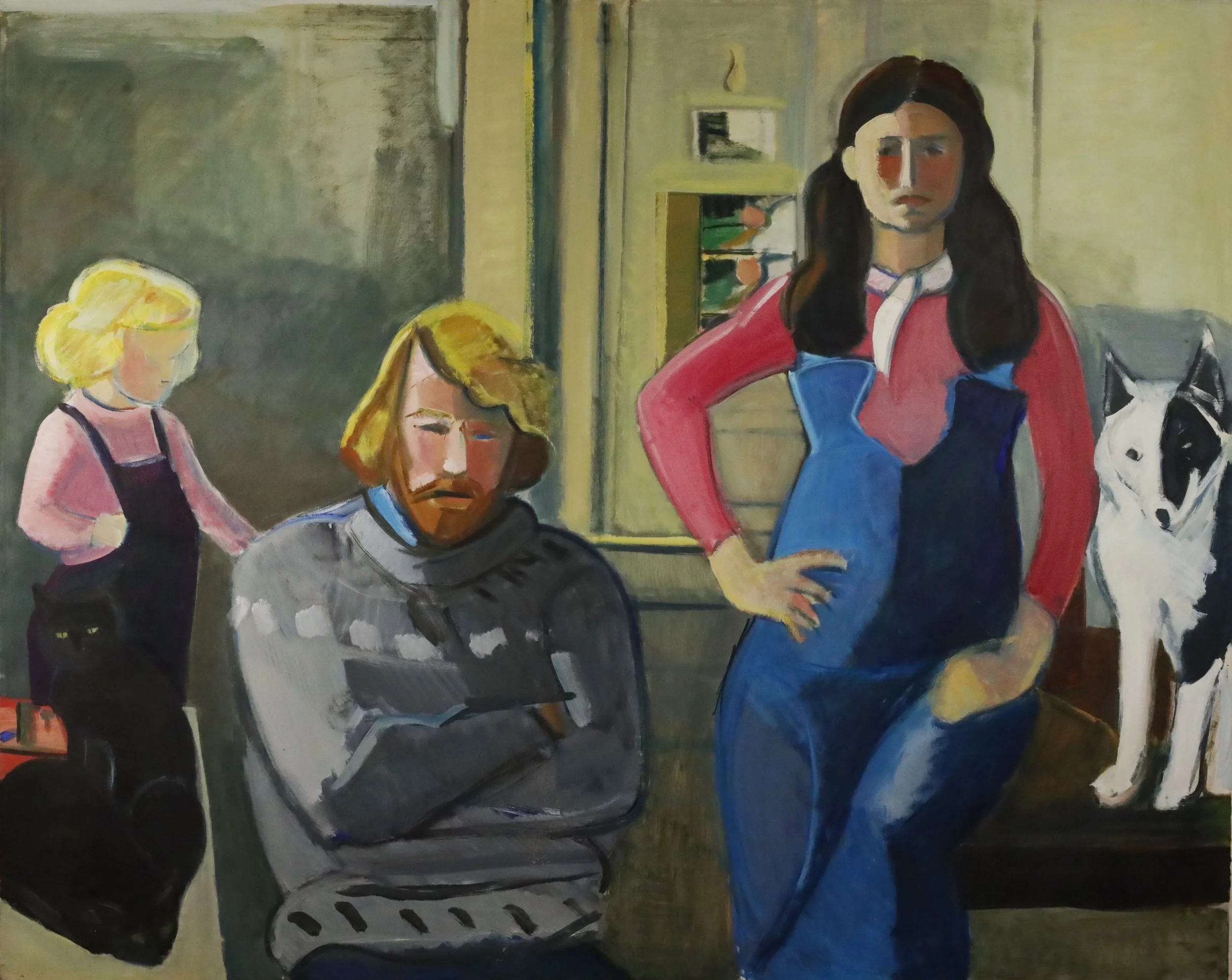
Temma Bell, Family Group, Oil on Canvas, , 48" x 60", 1981
Eileen: I would love to hear the story of how Ulla came to be the one to curate your show.
Temma: I turned 80 last June, and my daughter has been working on fine art pop-ups to connect with new audiences. She suggested we create a survey of my work—and that’s how the idea for this show was born. My daughter shared, “My mother has always devoted so much of her energy to promoting my grandparents’ work, and with this show I really wanted to celebrate the strength and beauty of her own paintings. I think it came together so beautifully, and I’m so happy to share it. It feels especially meaningful to me now as a mother of two daughters—to be able to show them the art I grew up with.”
Eileen: I love that. Forgive me for not knowing, is Esja your husband?
Temma: My husband’s name is Ingimundur. Esja is the mountain you can see from Reykjavík—it’s a beautiful backdrop to the city. My mother painted it, I have painted it over the years, and my granddaughter’s middle name is actually Esja.
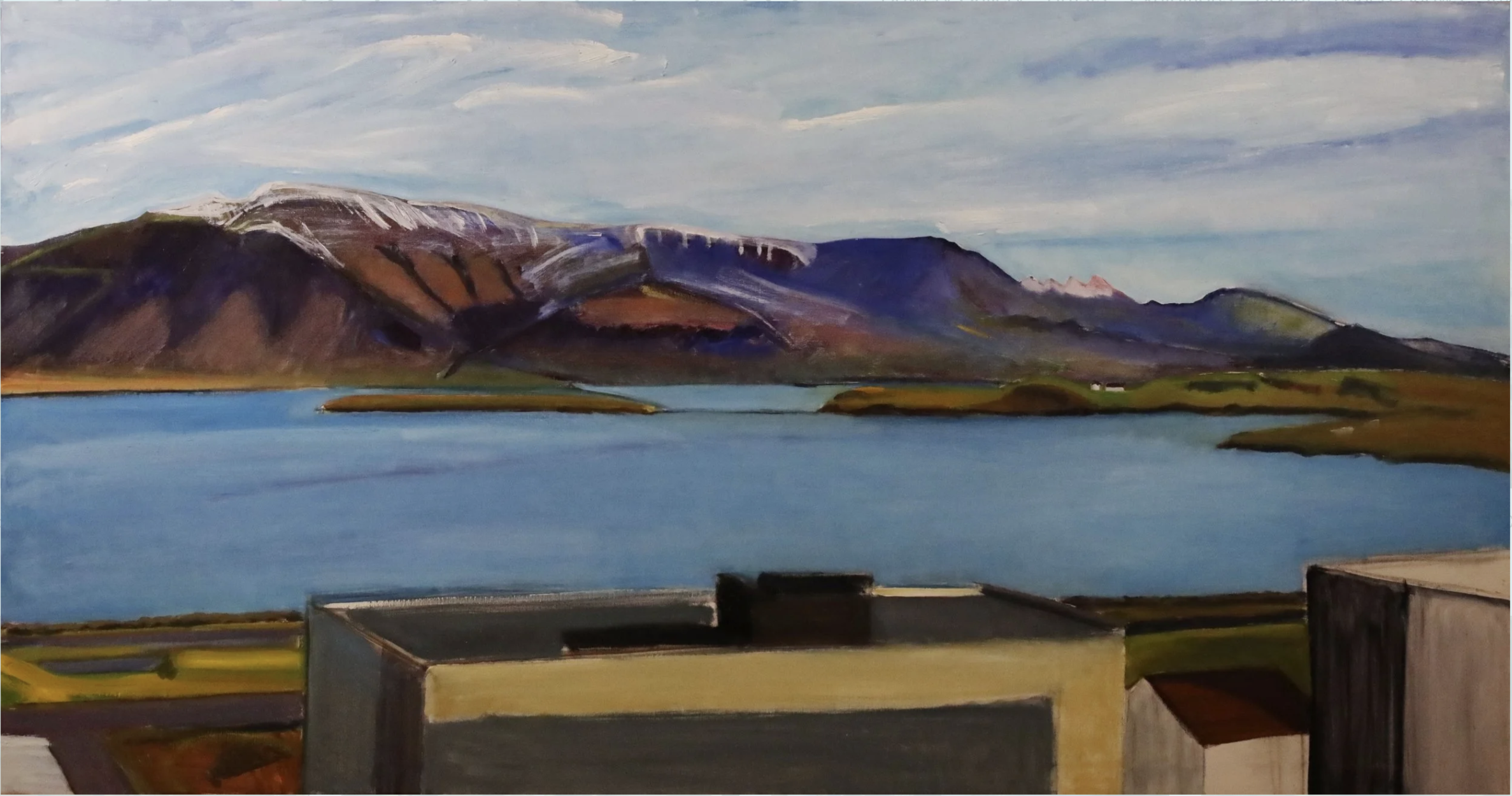
Temma Bell, Ejsa and Fjord, Oil on Canvas, 32" x 60", 2006
Eileen: You are reminding me of something I believe that I read in your press release–you mention that what you paint has to matter to you. From Esja and your landscapes, to the rest of your expansive body of work, which includes domestic scenes of you and your family, and finally still lifes that are very much embedded in your domestic world. I have a couple of questions about it.
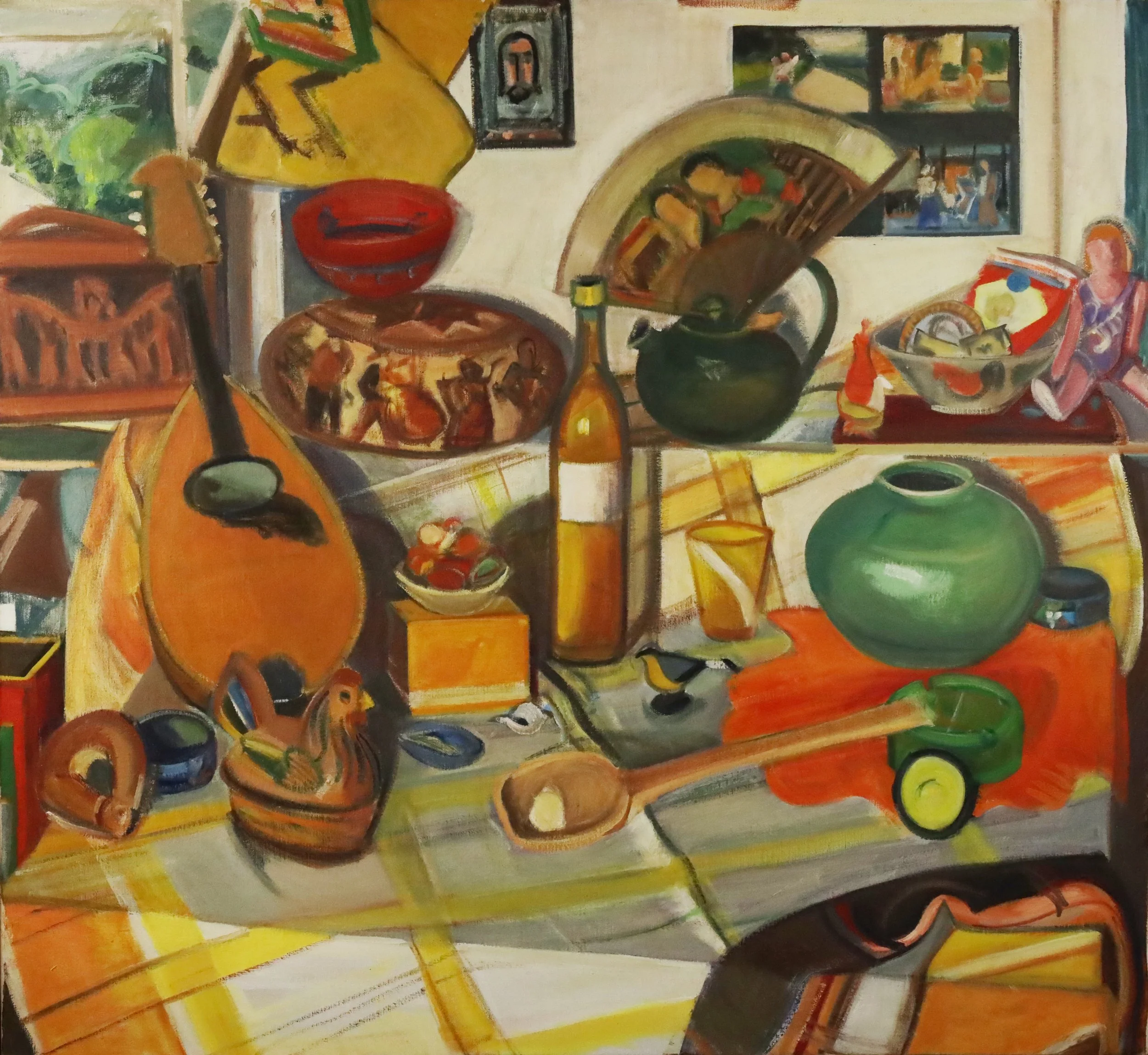
Temma Bell, Icelandic Still Life, Oil on Canvas, 42" x 46", ca1978
First, I would love to hear from you about your approach to setting up a still life. They seem to have a common structure, and the recipe for that structure appears to involve a certain amount of complexity, along with multiple planes where objects live–not just one still life setup on a table in front of a wall, but a still life setup with another one behind it. Can you share your process of constructing your setups? I am looking at Icelandic Still Life and Fern Basket with Straw Fish.
Temma: Still lifes are always interesting. The objects will have had meaning to me and I am always interested in complexities, it is fun to move around the canvas a bit like a dance, and of course one loves to play around with the color and light and hopes to give life to it all.
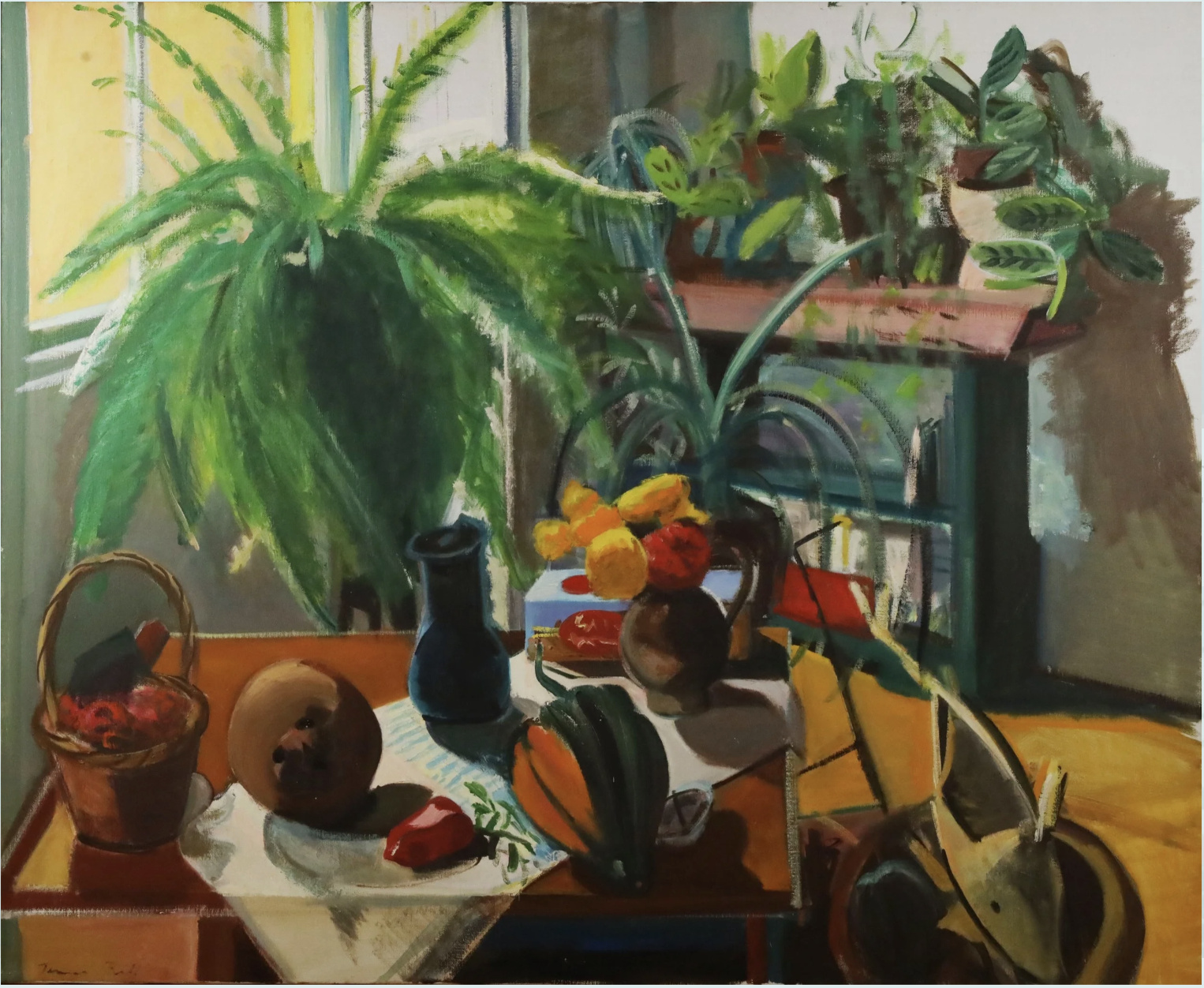
Temma Bell, Fern Basket with Straw Fish, Oil on Canvas, 48" x 33", ca1974
Eileen: Second, with respect to your family paintings, I am obsessed with your gestural touch and the commitment to perception that they convey, while also maintaining an openness that veers into abstraction. I am wondering if you could discuss your process. Perhaps you can talk about the paintings, Family Group from 1981 and Ingimundur and Temma from 1977 to give you something to refer to.
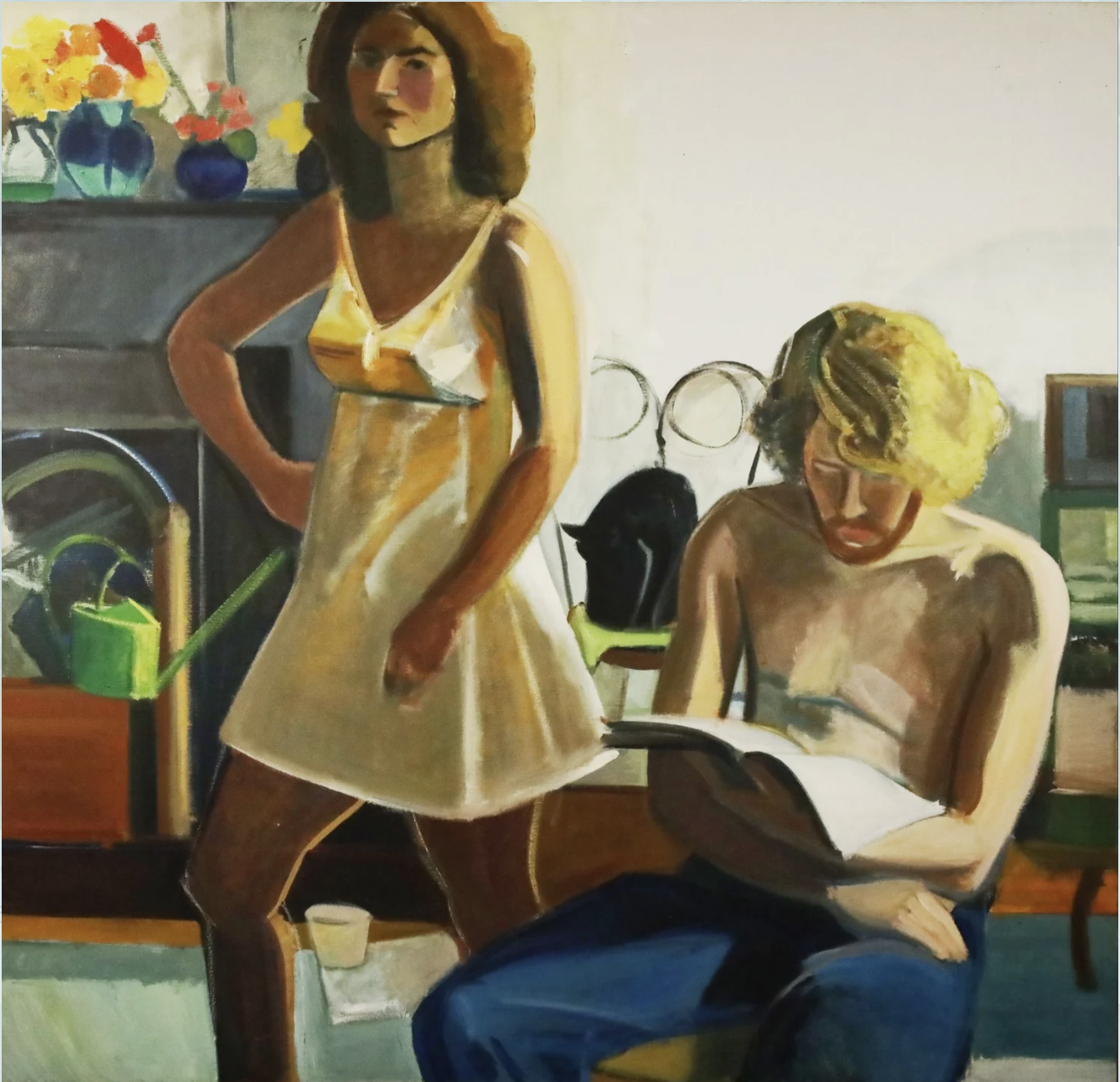
Temma Bell,, Ingimundur and Temma, Oil on Canvas, 50" x 52", 1977
Temma: As to process, I am not quite sure what that means. Do you mean the drawing that I might start with charcoal and then get into the paint? One is always moving around on the canvas to make it all work. I guess the abstraction part that you refer to is the dance that goes on when one is painting. Getting things to balance, things to work. The proof is always in the pudding…no matter what one says one is trying, the canvas tells it all…
Temma Bell, Then and Now is on view from April 21 through May 16, 2026, with an opening reception on Saturday, April 25, from 2-5pm.