Dorothy Frey: Glass Hatchet
Eileen: Dorothy, I am excited for your upcoming show at Bowery Gallery! I see that you have continued with still life. And I know from our interview from your last show that these objects are not just “still life objects” that are kept in a cabinet or on a shelf that have been collected for the purpose of your paintings. I remember you sharing that they are heirloom items and functional objects–all of the objects that are just sort of around the house. Your interiors contain these objects, and they feel like snapshots of your habitat and provide us with some context for your more intimate still lifes. I’m thinking of Brass Lamp. The still lifes are more zoomed in and feel like meditations on an organized chaos. I’m thinking about the painting, Souvenir. To start us off, I’m wondering if you wouldn’t mind talking about the dialectic between the interiors and the still life paintings.
Dorothy: Each recent painting features heirloom items, whether furniture in a larger environment or small objects arranged on a table.
My interior paintings represent our lived-in spaces, where we naturally arrange still life around us; whether significant objects that represent a place or memory, or everyday things scattered about.
The still life paintings magnify personal symbolism within the objects, embodying the women who have used, made, or cared for the pieces. Souvenir features a glass hatchet, gifted to me as a 6-year-old, from my grandmother, a year before her death. Some items in my paintings are not special at all, which makes me curious why I kept them…is it their color, their material, or the memory of the person connected to them?
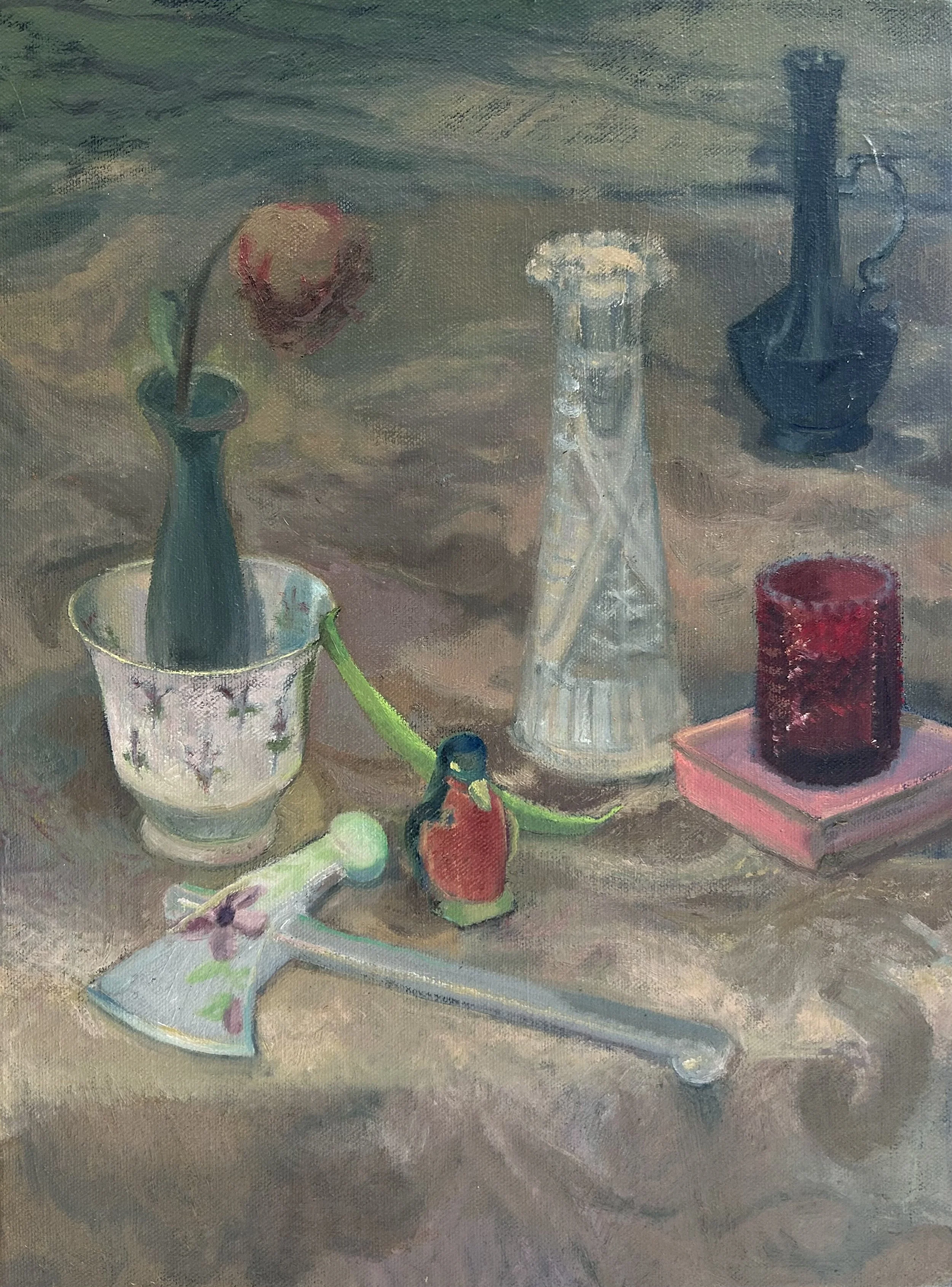
Dorothy Frey, Souvenir, oil on canvas, 16×12 inches, 2026
Brass Lamp is a little different. The scene is both interior and still life, depicting the storage shelf in my studio. Like a visual to-do list, the objects (to me) feel weighted like an unfinished task. They are expecting me to achieve a goal, to include them into a painting. The brass lamp, once in a stylish living room, now casts its light on the waiting objects.
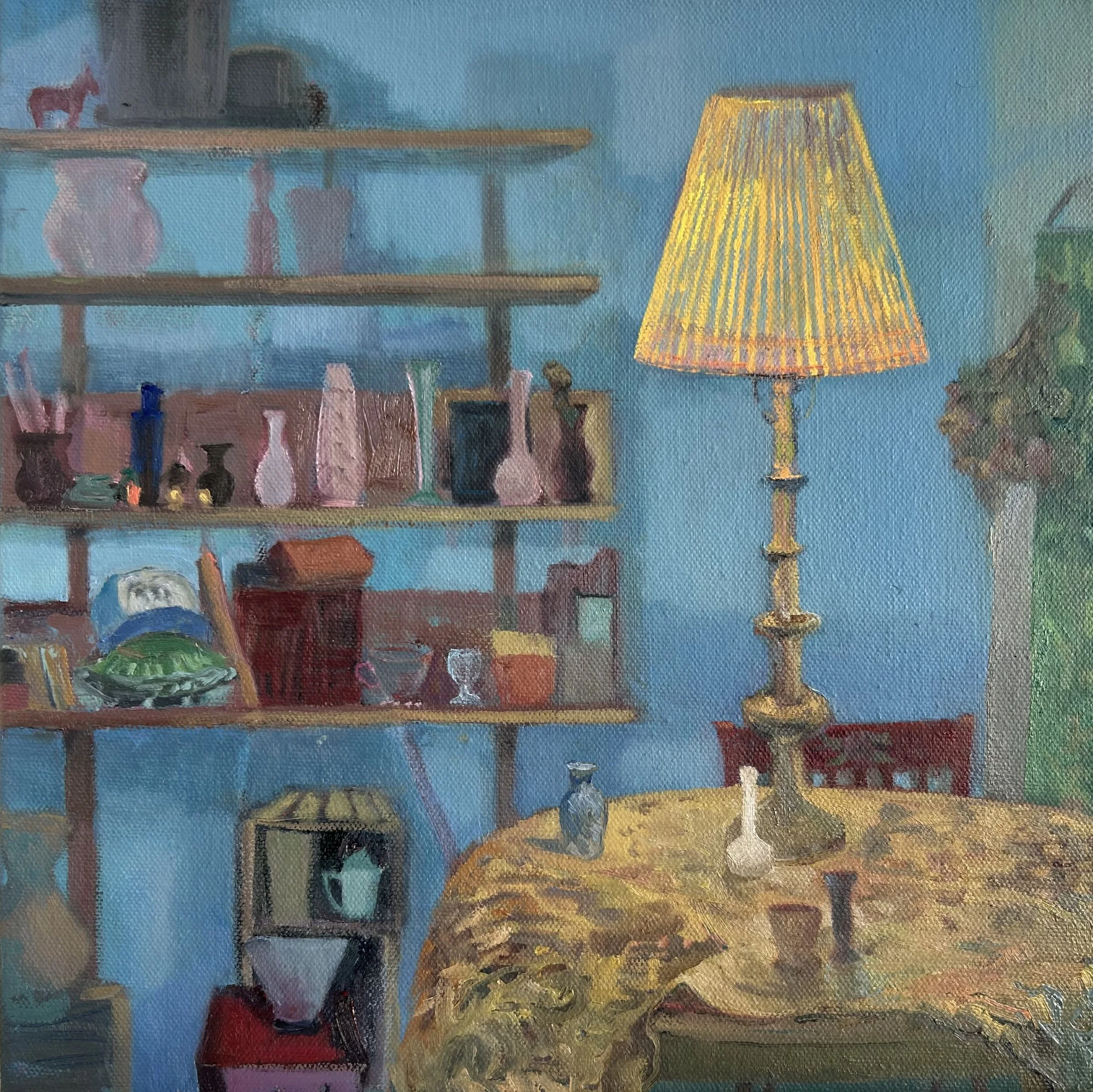
Dorothy Frey, Brass Lamp Family Tree, oil on canvas, 12×12 inches, 2026.
Eileen: I can absolutely relate to so much of what you’ve described here: having these shelves filled with objects, each waiting for their chance to play a part in a still life, and the “naturally arrange[d] still life around us.” I know that some artists set up their still lifes as if the objects are actors on a stage, while others choose an aerial view on an intentionally selected assortment of objects, or perhaps the terrain of one’s life. Yours seem to be a combination of both. I am particularly interested in where you choose to place your objects, and where you create clearings–like a clearing in a landscape. For instance, in Clock of Eras, you put a lot in the foreground, and then create a clearing in the middle, with more objects further back. You do something similar in Waiting in the Wings, though I can see that there are two levels in that piece. Conversely, you also have very cluttered spaces, such as Vessels and Apron (Generational). Can you walk me through how you set up your still lifes?
Dorothy: Setting up a still life is a fluid process for me; the arrangements evolve constantly and sometimes disappear altogether. I work from observation, intuition, and memory. I pull objects from the studio storage shelf for closer inspection, switching between them as the painting develops. Transparent glass vases, pops of color, decorative textures, or quirky trinkets each offer something different in the painting, as an opportunity to shift the visual rhythm or deepen the meaning. This responsiveness allows the painting to unfold through both intention and discovery.
I have been working with two textiles for several years. The bold, red and white Swedish print brings a crisp, contemporary energy, while the tan and gold jacquard carries a sense of history. The choice of fabric becomes part of the symbolism. I love your phrasing “the terrain of one’s life.”
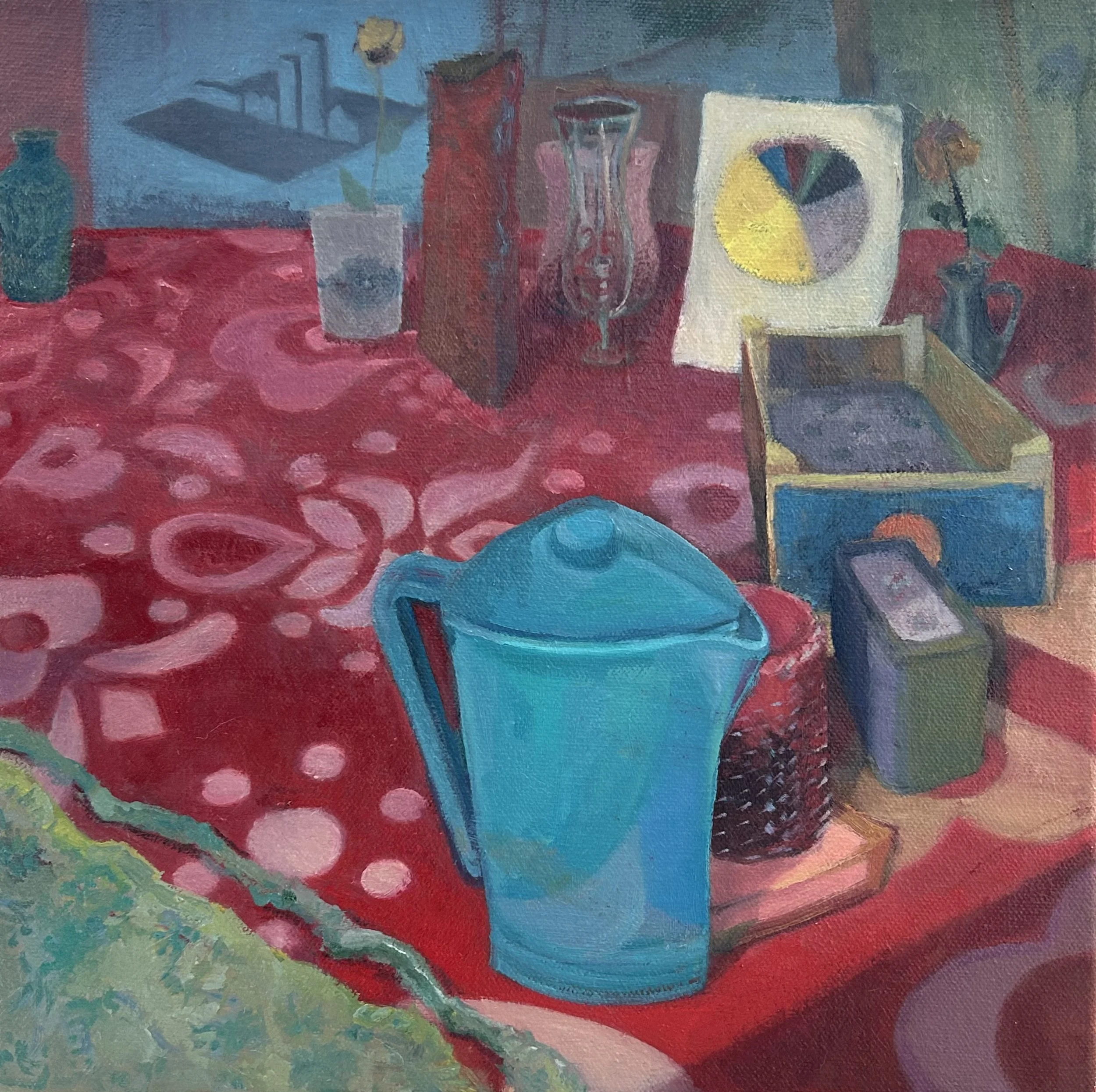
Dorothy Frey, Clock of Eras, oil on canvas, 12×12 inches, 2026.
Clock of Eras' beginning was more akin to a stage set. My intentions became more realized when I added my son’s drawing of the Clock of Eras. The circular diagram reshaped the layout, and the painting revolved around the presence of circles throughout the composition.
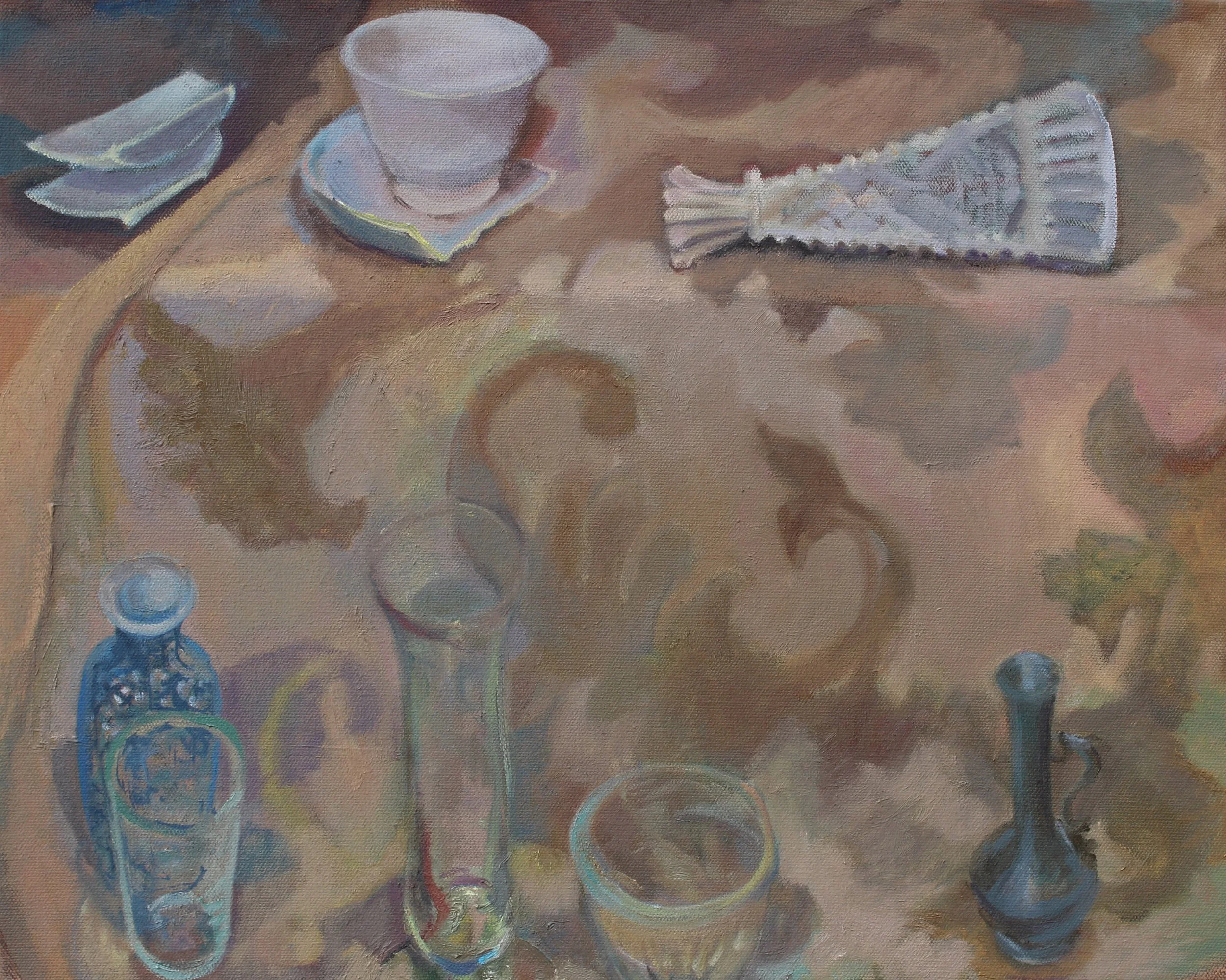
Dorothy Frey, Waiting in the Wings oil on canvas, 16×20 inches, 2026
Waiting in the Wings emerged after I discovered a broken saucer from 1865. I felt sad, and put the pieces in the set up, to make amends. Damaged and fallen, yet illuminated on the top tier, the saucer and vase became a metaphor. Beneath them, standing sturdy, the other objects represent strength and more quiet form of support. Each of these vases represent a woman in my life, both present and past.
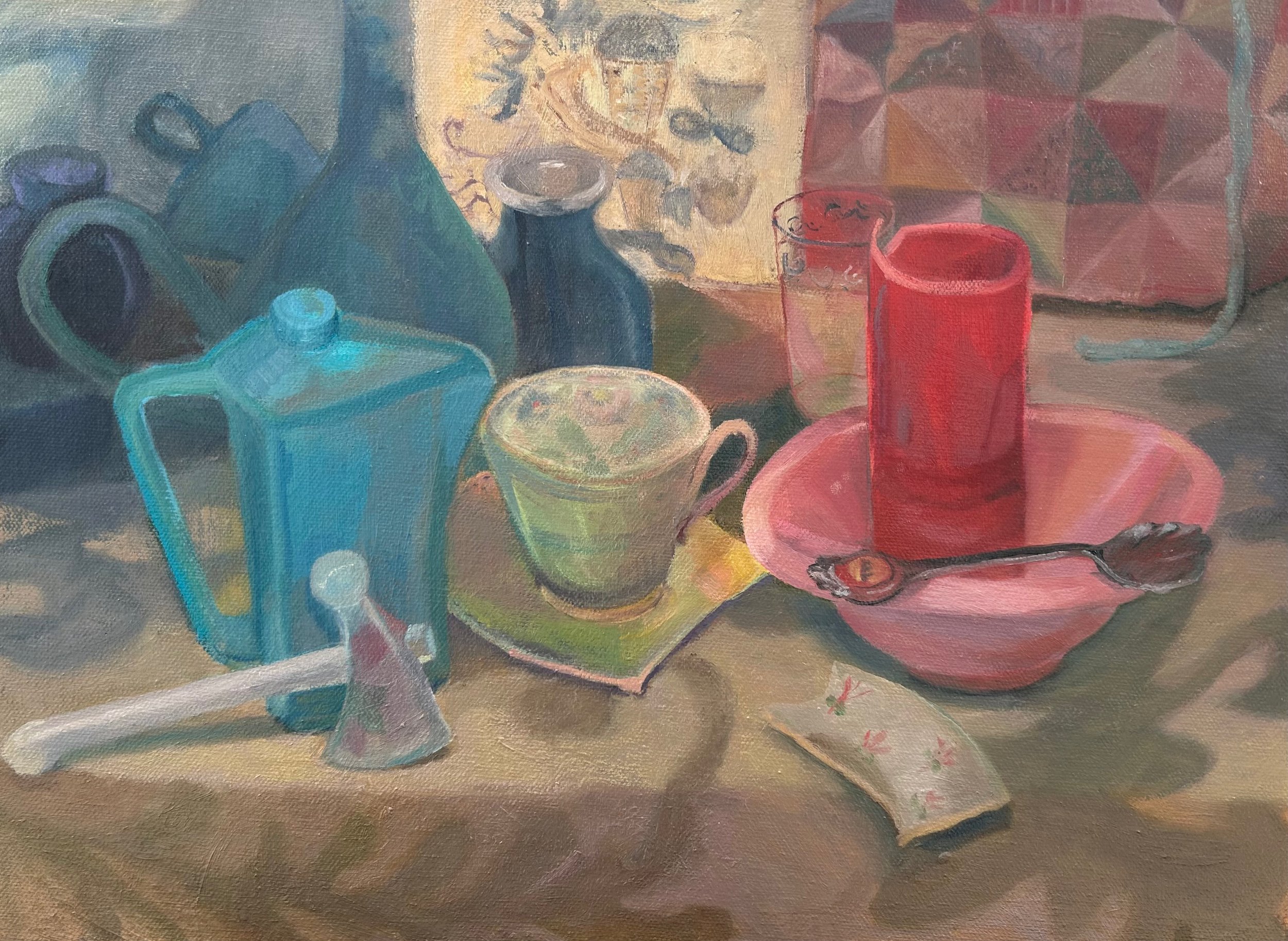
Dorothy Frey, Vessels and Apron (Generations), oil on canvas, 12×16 inches, 2026.
In Vessels and Apron (Generational), I continued populating the arrangement with more objects and symbols. The accumulation felt like a gathering of the women, like a cast of characters on a stage.
Eileen: It seems to me that you are not only playing with space within the setup, but also how you are managing it in your paintings. In particular, I am thinking about Divided and Visual List. There is something in these that feels a little like a departure from some of the others (though maybe this group includes Waiting in the Wings). You seem to be playing around more with flatness, with generalizing towards abstraction, yet creating something very atmospheric. They remind me of Matisse, but also of more contemporary painters such as Gwen Strahle and Mark Milroy. Their atmospheric qualities reference something somewhat metaphysical, as well. Can you talk more about what else you are investigating in your paintings, beyond the visual setup of the still lifes?
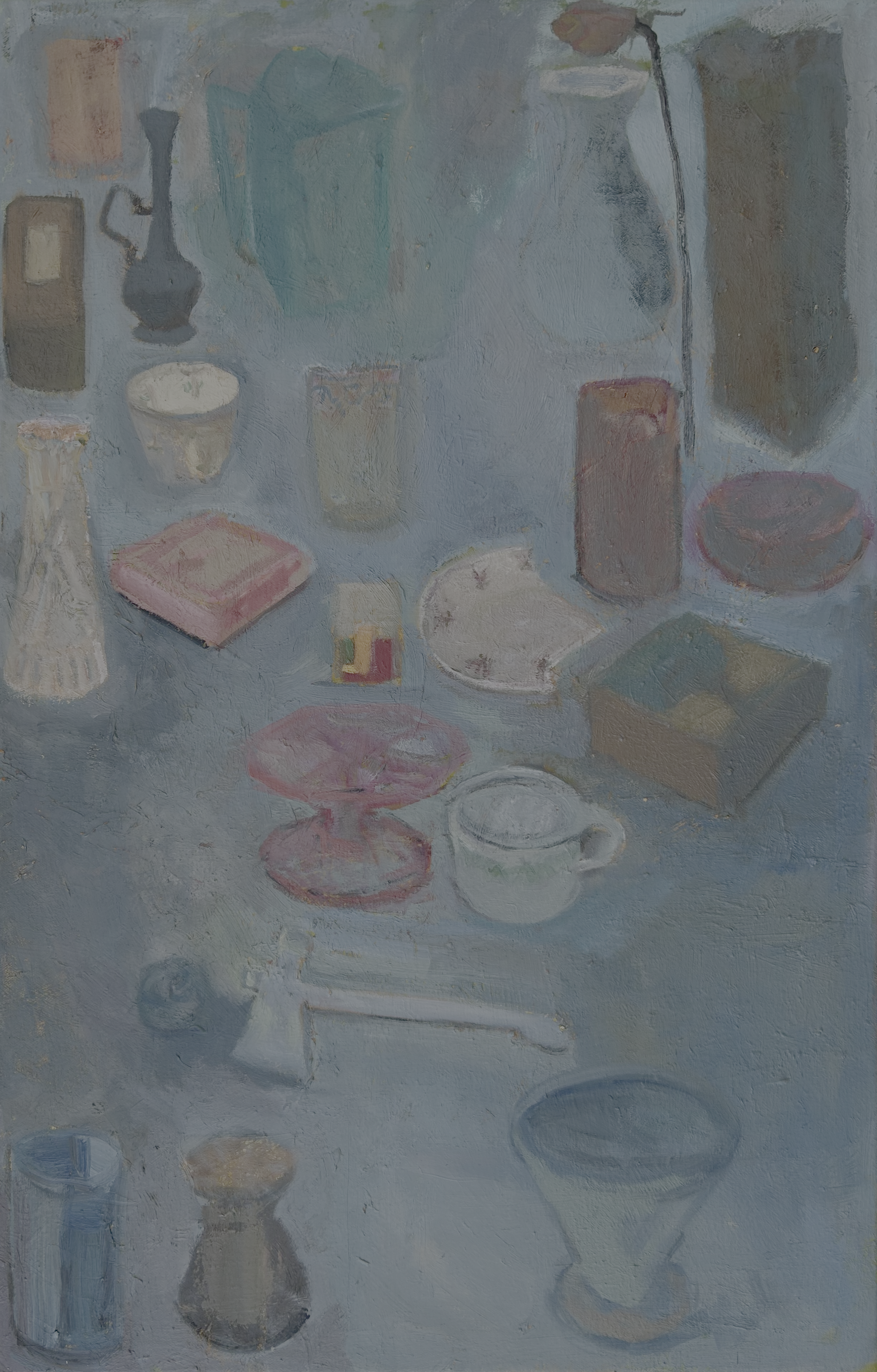
Dorothy Frey, Visual List, oil on canvas, 28×18 inches, 2026.
Dorothy: Visual List was the first painting I began in this new series, but one of the last to resolve. I had been looking at some Egyptian tomb paintings which included still life. Their direct presentation of food, fish, and vessels is straightforward, documenting each object without overlap. That approach inspired me to give each object its own space, independent of the others. Divided uses the two textiles I refer to above, one relating more to now, and the other to history. I am still wondering about these paintings, so I have less to say about them.
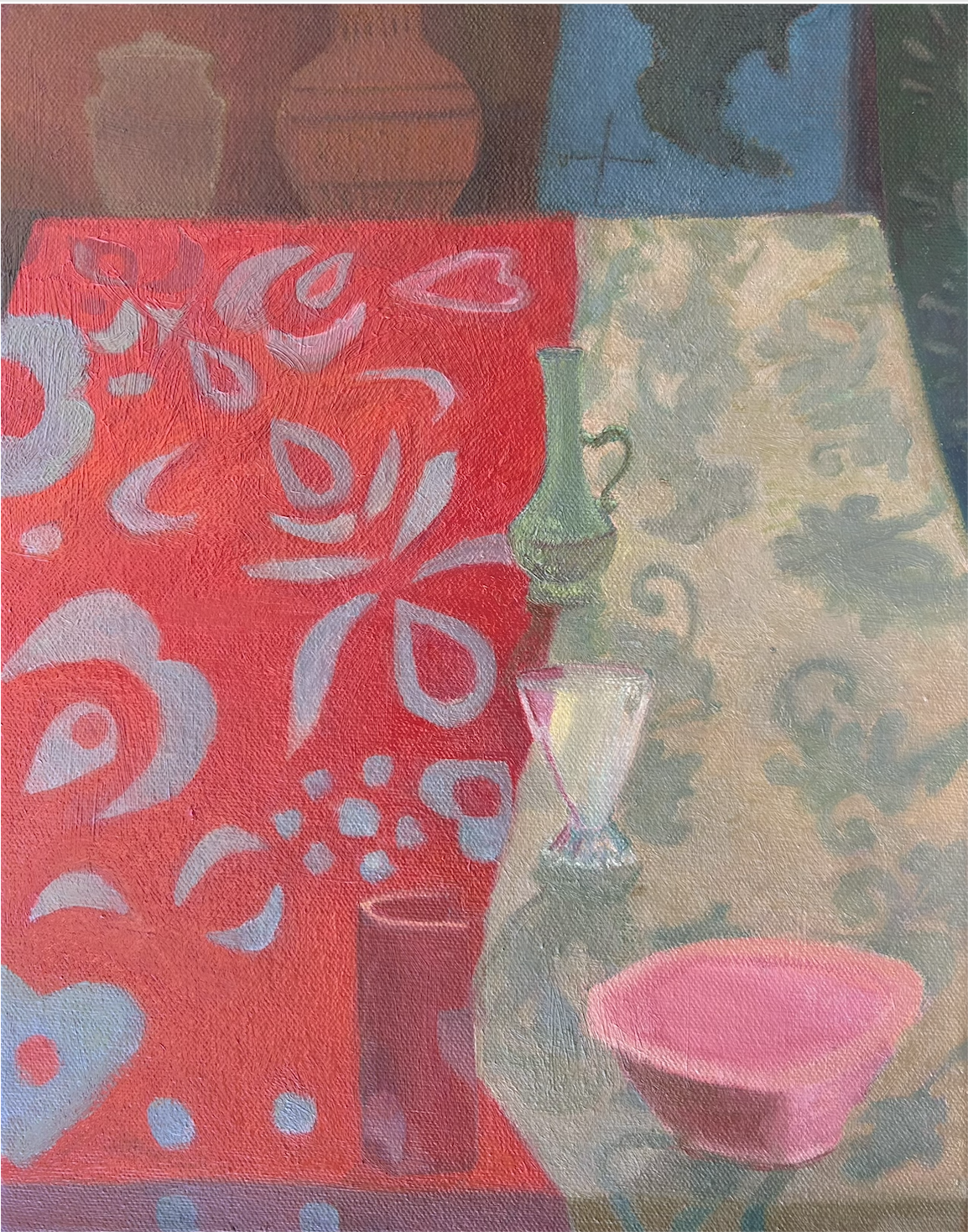
Dorothy Frey, Divided, oil on canvas, 11×14 inches, 2026.
Eileen: Of course–I should have thought of Egyptian still life. It is an interesting contrast to Vessels and Apron (Generations), which is a tight space that contains several objects, with the narrowest of passages through and between the objects. That piece is interesting to me because it seems to be organized by color, from left to right: blues, then yellows, then reds. On that note, your work seems to be veering towards more primary color combinations this go around. What are your thoughts on color in this show?
Dorothy: The objects and the textile really guided my color choices. Although I often invent color, I found myself drawn to reds more frequently than usual. As with Vessels, once I noticed the primary colors, I emphasized it as an organizing principle. I was also thinking about how Divided is structured into sections of color, and I like finding these kinds of crossovers in multiple paintings. For years, my paintings have been rooted in the greens from the verdant, mid-Atlantic farm landscapes. I am enjoying how these objects impact the color framework of the work.
Eileen: You are reminding me of our Zeuxis Conversation, and how motherhood has sort of brought you inside to work–since you have been more of a landscape painter in the past, right? I just really appreciate that your approach to still life is not just about a certain little army of objects that are used and reused, but rather, are your family’s heirlooms–which are similar to your landscapes, as they are often of your family’s farm, correct? No matter what, it is very personal. I guess that brings me back to the terrain of your life. Whether you’re able to be outside or inside, your paintings seem to be a meditation on the decades-long relationship that your family has with their environment and with farming. It’s almost anthropological, or even autoethnographic.
Dorothy: Yes, the terrain of my life! I expect to be outside painting again. I also am completely intrigued with the still life and interiors - in the past they were a diversion from the landscape. But they are fully holding my attention right now.
Dorothy Frey: Glass Hatchet is on view at Bowery Gallery from March 24 through April 18, 2026, with an opening reception on Thursday, March 26, 2026 from 5-8pm.