Naomi Nemtzow: Recent Work
Eileen Mooney: I know that you are aware of the many different interpretations of your work, from machines to maps to animals. To me, they remind me so much of Paul Klee’s Twittering Machine. I feel like I am seeing birds in them all over the place–birds, and maybe even reptiles. Your work has a child-like feel to them, in some ways similar to Klee’s work. I know that you started making this work during Covid when you were sitting in zoom meetings and such. Since you have now been working on them for a good few years, has this changed who you like to look at?
Naomi Nemtzow: Yes, I’m also aware of birds and reptiles showing up in the work. I really don’t have an explanation for why that is or where they come from - but they do seem to show up on a fairly frequent basis. Fish also. I’m okay with “child-like,” and I certainly enjoy and admire Klee. I very much enjoy that different people see different imagery in the work. But yes, the birds, reptilian creatures and fish seem a bit more explicit. Also various sorts of “vehicles.” I did paint a lot of cars and trucks from observation in my earlier work, along with roads and bridges. I think those elements have followed me into this work.
In terms of who I like to look at, I like a lot of different kinds of art. I certainly haven’t lost interest in my lifelong loves, and I’ve picked up quite a few additions over the years. I don’t think it’s specific to the changes in my own practice.
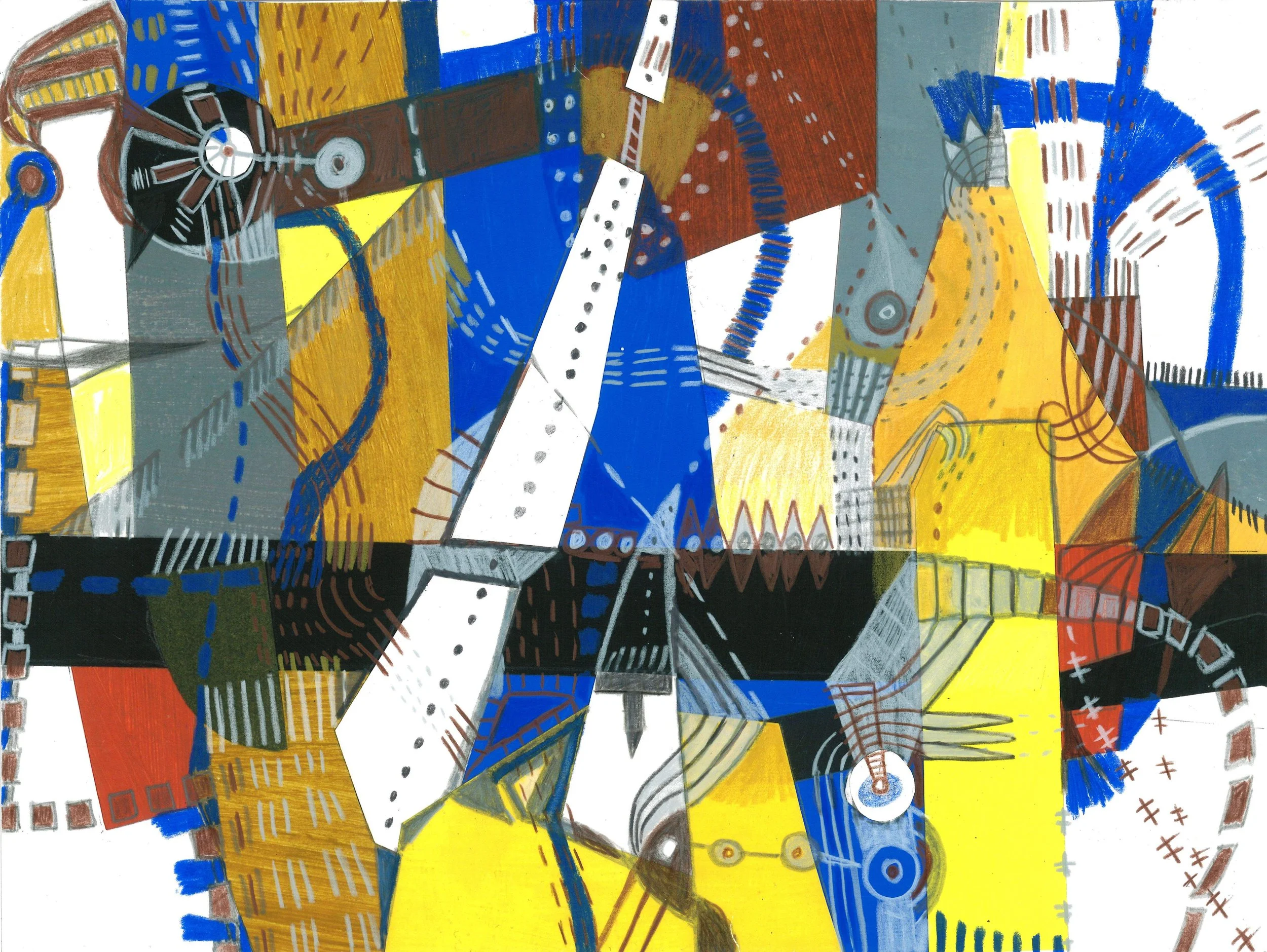
Naomi Nemtzow, This Way Please, cut paper, mixed media on paper, 11×14 inches, 2024.
Eileen Mooney: It is interesting to hear you talk about the streets and bridges that you’ve brought from your perceptual work. The more I look at them, the more I agree with those who have said that they have a map-like quality to them, and I wondered if that was intentional.
Naomi Nemtzow: Several people have mentioned that map-like quality. I wouldn’t call it intentional, exactly, but here’s where it comes from: I started each of these pieces by first placing several shapes of the same color on the page, for example a dark red. I arrange them so that the eye moves from one to the other, a kind of visual pathway from red to red to red. I then add shapes of a second color, say an ochre, establishing a rhythm of ochre as a counterpoint to the rhythm of red. I usually then do the same with a third color, maybe a gray. Now there are three visual pathways established: red to red to red, ochre to ochre to ochre, gray to gray to gray. Those visual pathways play off each other. Then I begin to draw. I draw dotted lines and dashed lines and lines made of repeated small shapes, connecting the shapes to each other. I think it’s the interplay of these broken lines with the solid shapes that make for “map-like.”
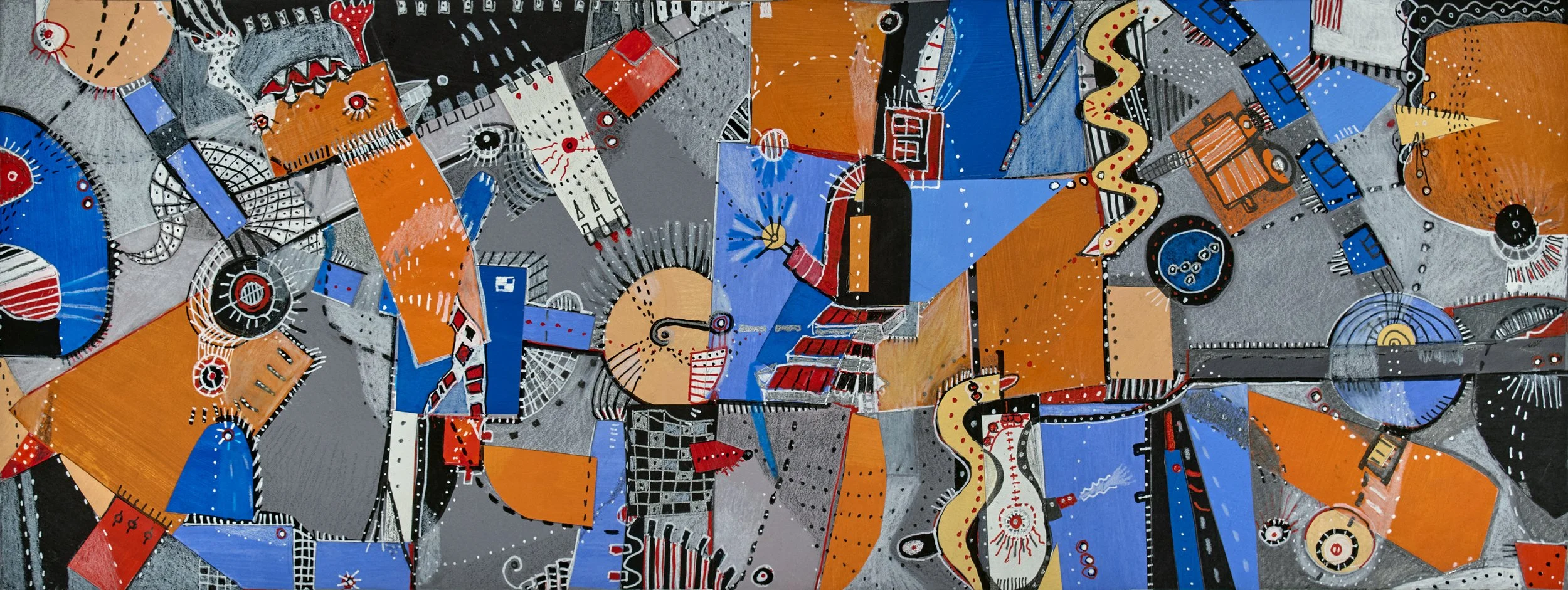
Naomi Nemtzow, Neighborhood Watch, cut paper, mixed media on board, 9×24 inches, 2024.
Eileen Mooney: Yes, that makes total sense. One thing that I find really interesting about your work is that there seems to be three different versions of these collages–some that stay contained within the rectangular plane, some that pop out of it a bit, and some that are fully liberated from the rectangle. Can you talk about the distinction between these? What leads you to keep a composition contained within the rectangle, and what causes you to open it up?
Naomi Nemtzow: Good question! All the pieces in this show started with rectangular compositions, sometimes one rectangular composition, and sometimes several smaller rectangular compositions combined into a larger piece.
Composing within a rectangle, limited by 2 sets of parallel lines joined by right angles, is a central challenge of all 2-dimensional art, and I find it endlessly fascinating. When I draw from one of the masters, such as Bellini or Brueghel or Corot, I want to know how that artist used the rectangle. From that point of view, one might argue that making shaped work is cheating. There’s part of me that quite believes that. And here I am making shaped work. I’m allowing shapes and implied forces to push right through the boundaries of the rectangle. In some sense, I believe the rectangle is always implied, if not visually present.
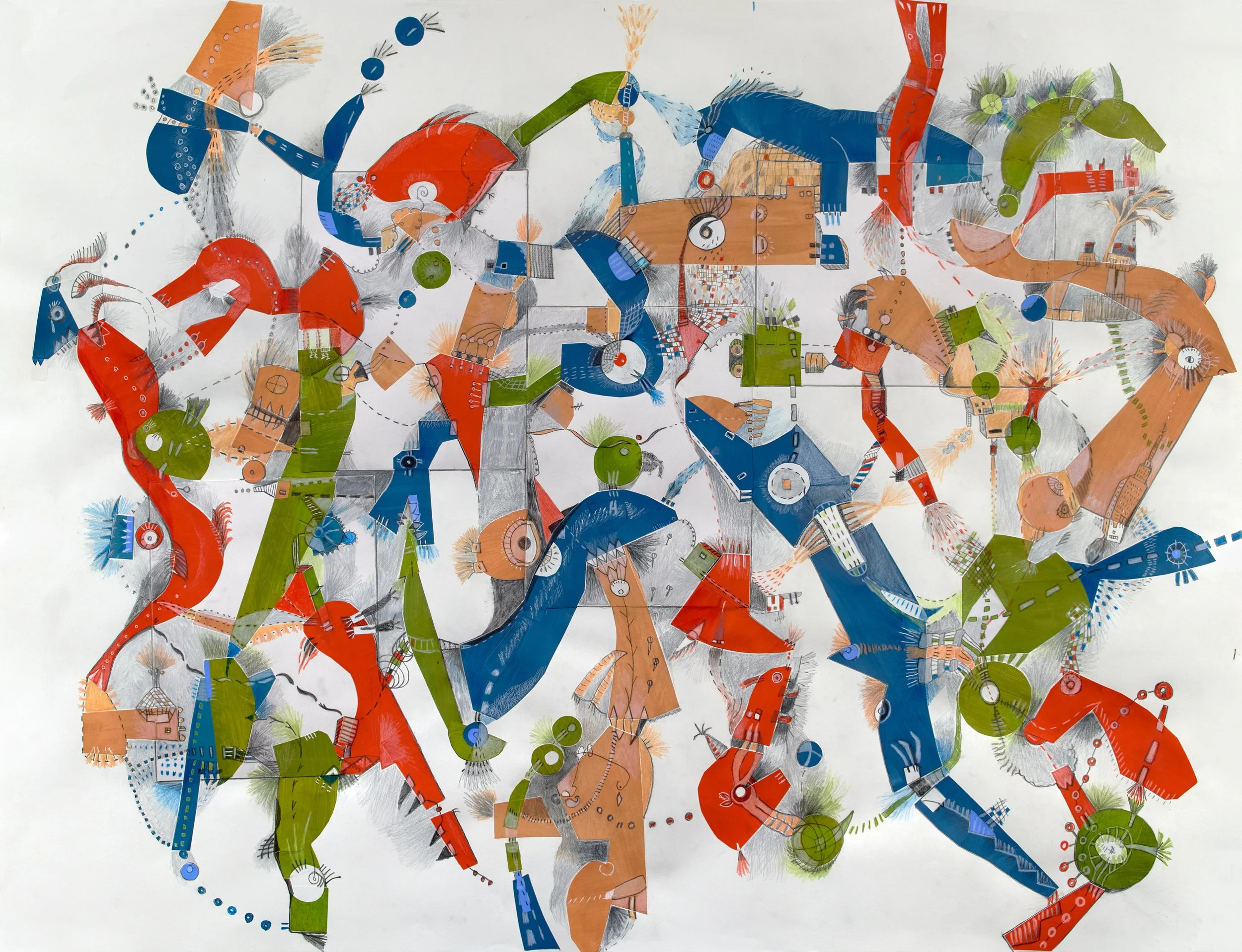
Naomi Nemtzow, Where is Home, cut paper, mixed media on paper, 38×52 inches, 2025.
There are various trajectories to how some works become shaped–or remain rectangles. My large rectangular piece, “Where is Home,” began as a series of four 11”x14” collages done as a series, using the same palette of red, tan, green and blue. I then assembled those 4 collages on a large piece of watercolor paper, and if you look for it, you’ll see the edges of the 4 smaller collages. I then built out from there with the same palette, extending shapes outward. I fully expected that this would become a shaped piece but it never did. I became increasingly interested in how the shapes and marks growing out from those four small original collages related to the edges of the larger rectangle.
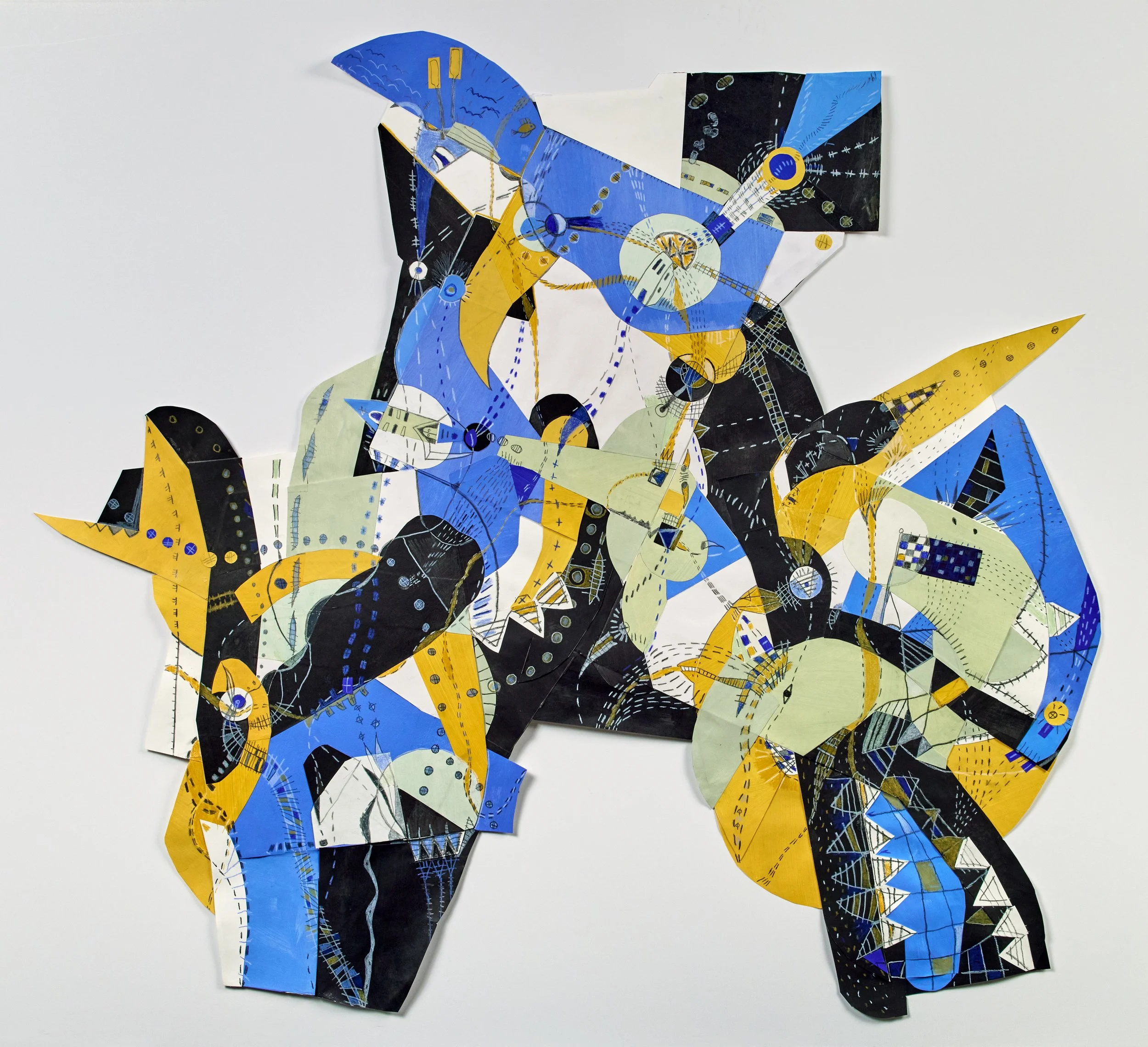
Naomi Nemtzow, With Claws and Teeth, cut paper, mixed media on board, 38×42 inches, 2026.
With the large shaped piece “With Claws and Teeth,” I composed on a large rectangular paper but then cut away parts of the rectangle that had become unnecessary. So that was a subtractive process of arriving at a shaped work.
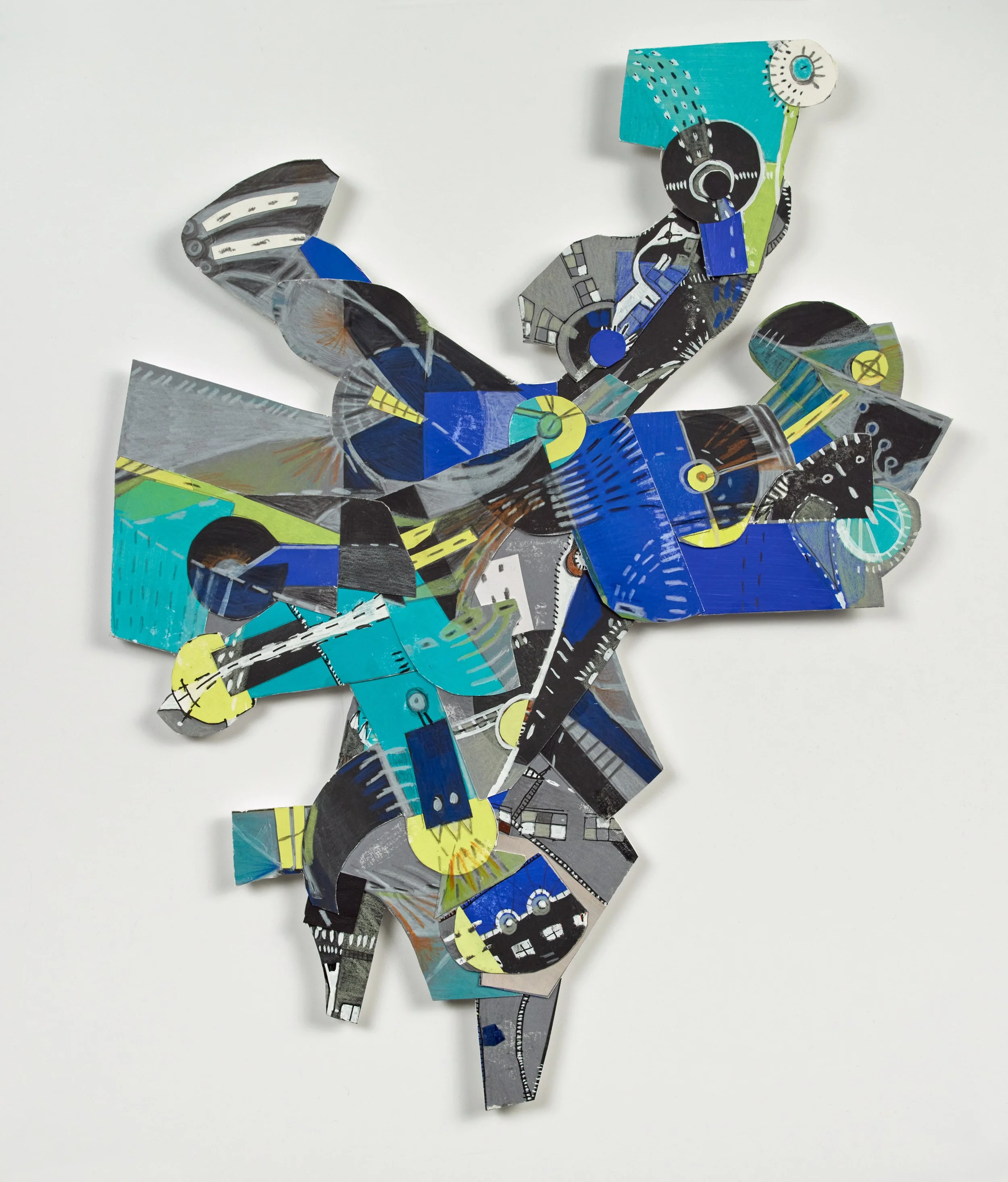
Naomi Nemtzow, Warrior Dance, Cut Paper Mixed Media on Board, 18.5×14.5 inches, 2025.
Most of the smaller shaped pieces, such as “Warrior Dance” and “Bird Squad” came about differently. Those are the result of my having found a number of 11”x14” rectangular pieces from 2023 that I wasn’t happy with. One by one I cut them up and reassembled the pieces into what you see now. Those are the most recent pieces in the show.
Eileen Mooney: I’m very interested in your transition from perceptual to nonobjective work. Do you still work from observation, or have you fully departed from that practice?
Naomi Nemtzow: I sometimes draw from observation, although probably not as much as I used to. Would I paint from observation again? I certainly wouldn’t want to rule that out.
Eileen Mooney: I watched the video from your artist talk from 2022 with Rita. I was struck by something that you said about your experience with this work versus your representational work. I don’t remember exactly how you put it, but you said something to the effect of the perceptual work being more laborious, and this newer work as being more joyous. Can you possibly say more about that?
Naomi Nemtzow: When I started working out of my head in 2020, it felt tremendously liberating. It was playful at a time—during lockdown—when the world seemed quite bleak. Earlier, when I painted urban landscape from observation, the goal was to create with paint, some convincing equivalent of my visual experience. That’s quite a worthy goal—and when I succeeded, it was truly satisfying. Other times, it was just plain frustrating! I didn’t plan to make this change–it just happened. The newer work also began to feel more personal, and there’s a different satisfaction in that. But if the world was bleak during Covid lockdown, then it’s absolutely terrifying now, as the forces of evil are digging in for the long haul. If I knew how, I would make work that addresses that reality head on, but without succumbing to superficiality. Meanwhile, my sense of humor and the absurd jumps in and tempers my horror.
Come see Naomi Nemtzow’s delightful show, Recent Work, at Bowery Gallery from February 24 through March 21, 2026. There will be an opening reception on Saturday, February 28 from 3-6pm, and a gallery talk, Rita Baragona and Naomi Nemtzow in Dialog, on Saturday, March 21 at 3pm.