Rita Baragona: Intertwining
Eileen Mooney: Rita, you have spoken in the past about your interest in chaos theory and physics, and that it informs your work. I am wondering if you could say just a little about that here. You don’t need to explain chaos theory–just what you take from it and how it informs your work.
Rita Baragona: The paintings were done perceptually without thoughts. In this show, the mind's understanding became part of the eye’s journey in the sketchbook pages. Perhaps more important to me is the question, “What have I found through painting perceptually that intertwines with what I have learned about physics in my reading?” I am most interested in the intertwining of constant change within an order of no change, or impermanence within the constancy of an overall aesthetic order.
In the eye/mind journey, I start with a question: What do I see once I know that energy equals matter? The closest I have come to answering it in physics is, “Energy and matter are intertwined. Energy moves matter and matter gives energy a place to be.” My visual language intertwines with the physics definition–that energy equals matter. Change is the intersection between energy and matter. Energy in matter is witnessed on the page as the spaces between–some close, some distant; some flow, some jump.
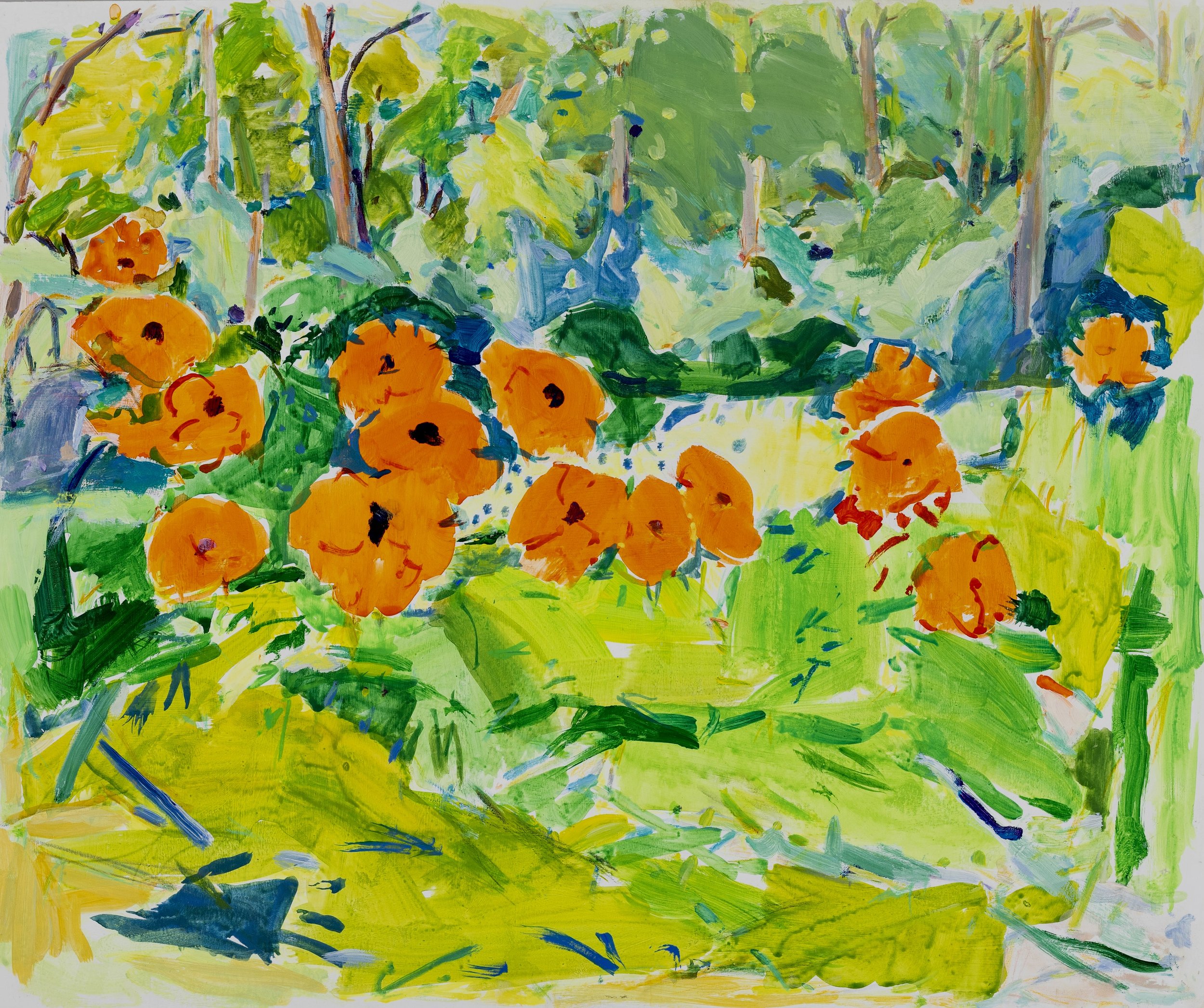
Rita Baragona, Poppies Dance between Woods and Ground, Acrylic on Paper, 13x16 inches, 2025.
In painting from nature, I see trees, oceans and flowers as pulses and flows of energy, which in turn make up their form and space. Oceans change fast; flowers change more slowly, and light is always changing. I see self-similarity and nuances within the complexity of chaos to order–which if I remember correctly, is part of the tenants of chaos theory. So I paint change, be it the chaos in a wave, as it breaks onto shore or intertwining of color and light in a still life. I paint or draw, attentive over time to flowers as they bloom and wilt or the ceaseless turbulence of waves getting in tune with their individual rhythms.
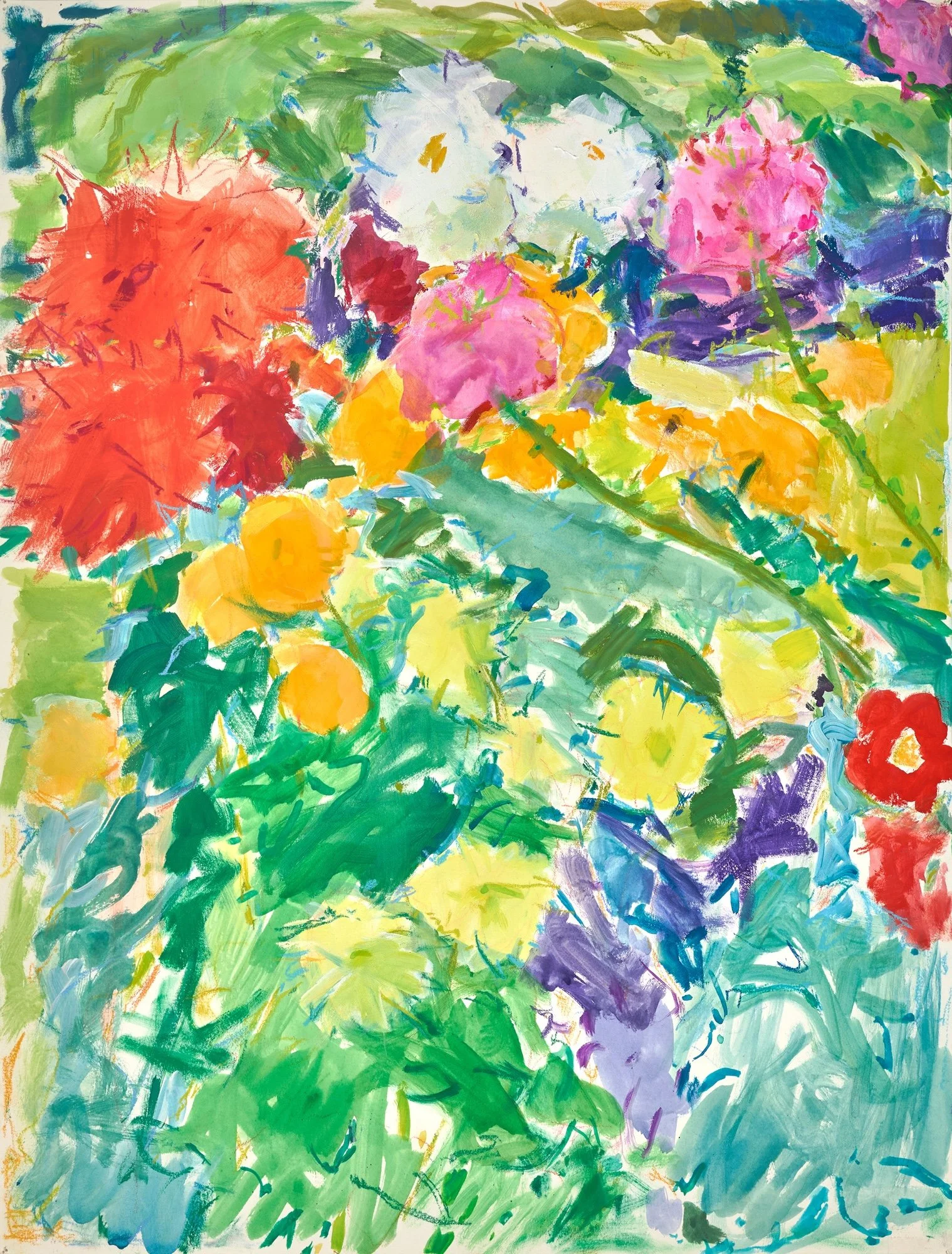
Rita Baragona, Blooming Cadences - Garden 2, Acrylic and Pastel on Paper, 24x18 inches, 2025.
I revel in painting ever-changing structures of color, light, and space, which at first feel chaotic. Pigment color parallels light color, which moves in jumps and flows similar to spatial patterns found in music or math. In the garden paintings, the spaces between color masses are delineated by rhythmic leaf, flower and focal point edges–which are not always found on object edges, but through eye movement. I notice how the leaves cascade downward like waves, so the composition is similar to that of my ocean paintings. The closest I get visually to an aesthetic intrinsic order is that luminous color acts as energetic masses delineated by rhythmic marks that give them form and space. My visual language intertwines with physics–that energy equals matter. In them, change is the intersection between energy and matter.
Painting nature’s turbulence somehow soothes my soul. I look outward to go inward. There are boundaries to the balance in nature’s chaos. The energy inherent in a wave moving forward hits the solidity of the edge and it breaks up moving irregularly in every direction. Roiling water as it hits the shore breaks up chaotically, but resolves as its energy subsides, and it rolls back into the sea.
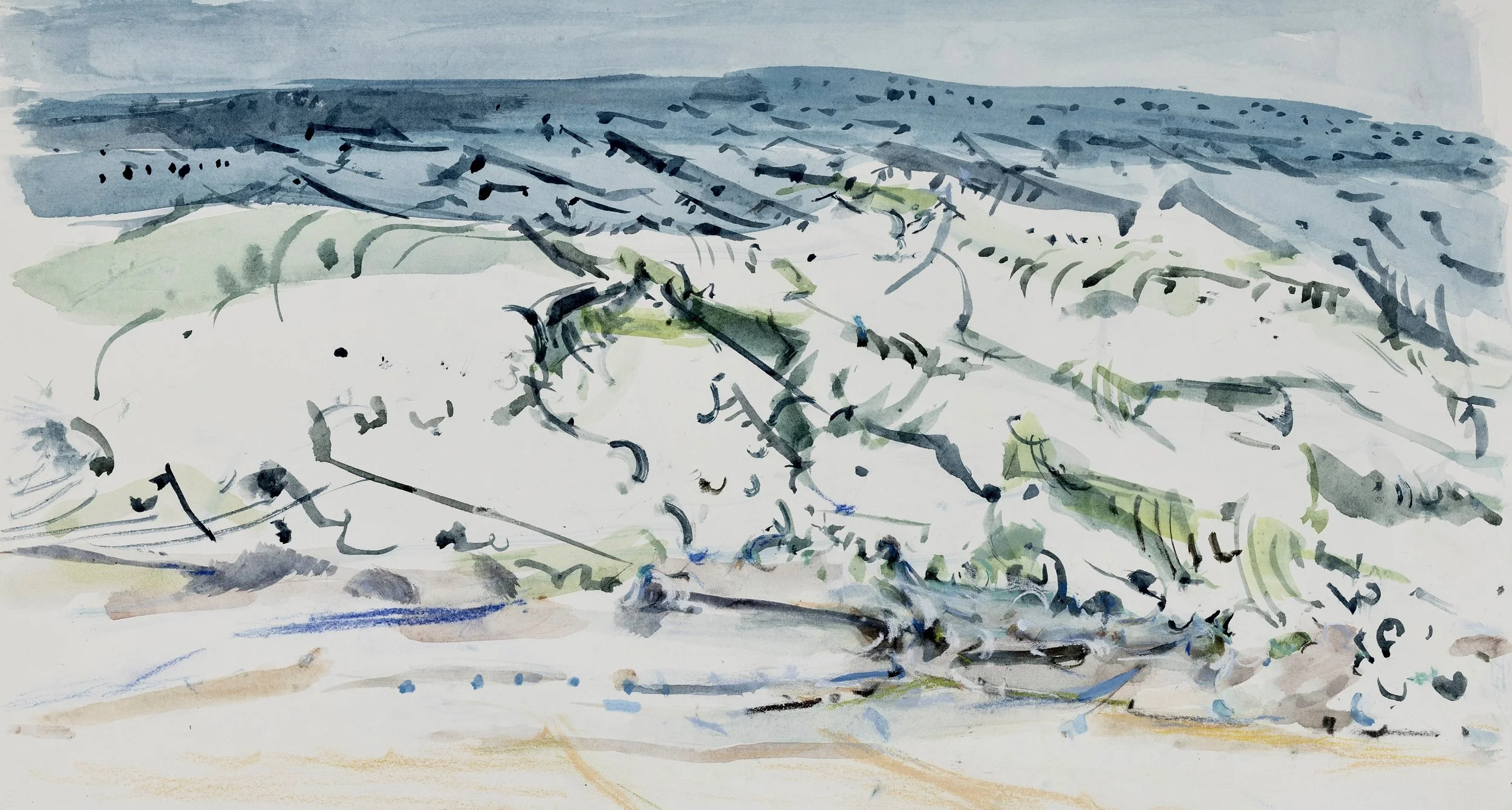
RIta Baragona, Momentary Ocean Chaos, Watercolor and Pastel on Paper, 12x22 inches, 2026
I ask myself, “Can I see and draw that?” I love the moment when I can see the order for a second in that chaos. Or when the tangle of branches or the enfolding of petals feels as though it has found a moment of balance. That moment of order in seeming disorder quells my soul. In a still life, when colors mesh together beyond their original identities, there is a moment of opening up, past its own self…and mine.
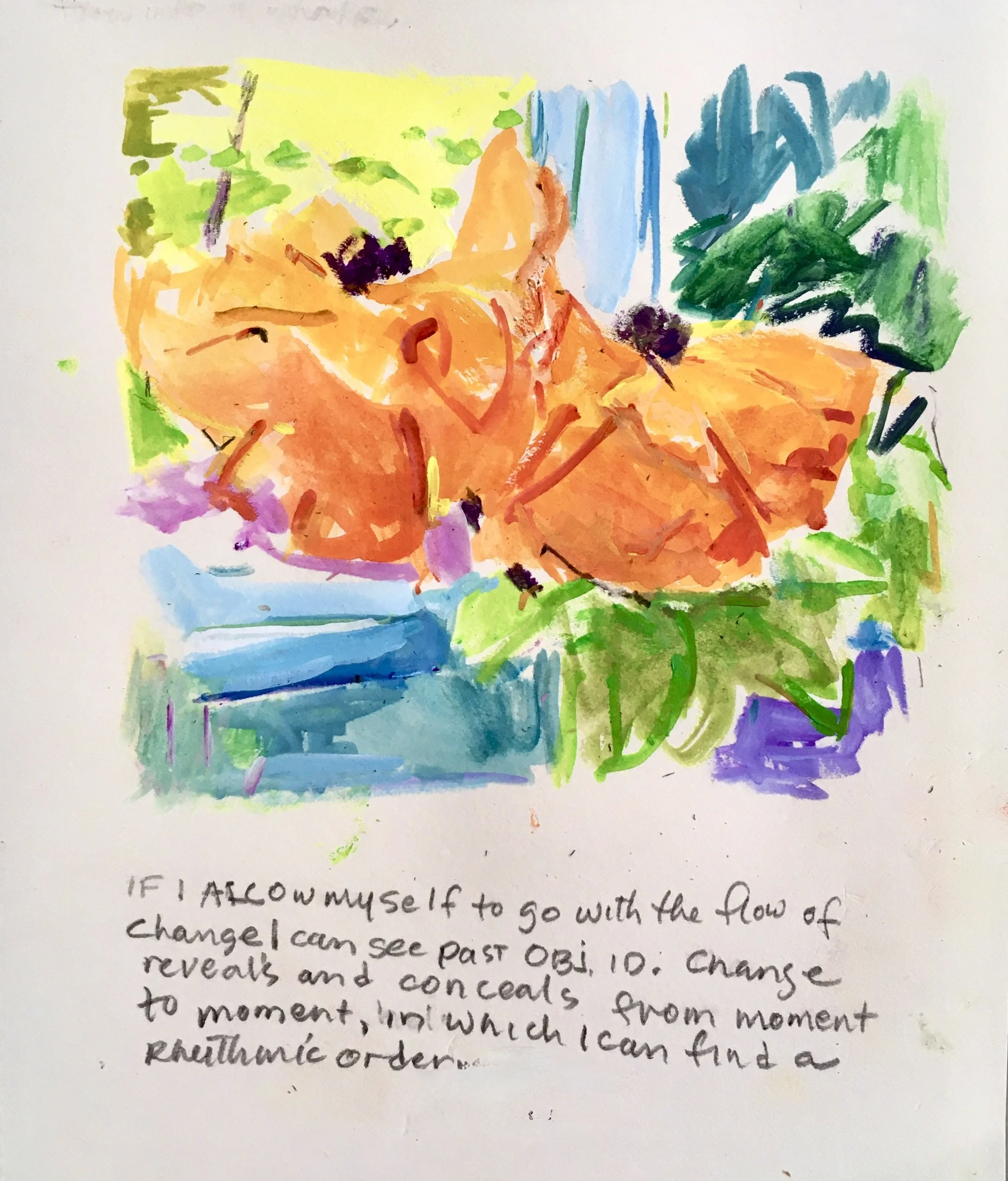
Rita Baragona, Poppy Cadences with Thoughts, Acrylic, pencil on Paper, 8" x 6", 2025.
In the balance between intuition and structural ideas in painting? I lean more on the side of intuition. But the answer is more complicated than that. We now know that eyes gather sensations which the mind organizes into coherent images. There is a symbiotic relationship between subjectivity and structural organization. I paint totally immersed in the visual using my emergent mind, intuition or full body mind. Sensibility is sense, mind, heart, and hand. I am happy when I paint and that happiness is reflected in the joyousness of the colors and lyrical forms of my paintings I hope.
Eileen Mooney: I am absolutely fascinated by your ocean/wave drawings, and in particular, your sketchbook entries that include notes. In one, you say, “Between stimulus and response there is a space. Between each moment there is a pause.” When I look at the drawing that you made underneath those notes, I wonder if your notes are separate meditations on your experience of the ocean, or if your mark making is an extension of the metaphor. Are the marks and the spaces between those marks a documentation of that experience?
Rita Baragona: Yes, those marks are notations of my sensory perceptions in the visual language. You are asking, though, which comes first: the thoughts or the painting. The thoughts come out of the painting and the visual experiences, which I am having at that moment. The painting always comes first. For example, one day, while painting the ocean at sunrise, experiencing the changing light and rhythmic pulse of the waves around me, I jotted down these thoughts beneath the painting:
All is in flux but more noticeable at times. Change happens faster when wave energy hits solid earth at the edge. Change happens faster at the edges of the day, at beginnings and endings, Change happens in the breath’s moment of birth and death.

RIta Baragona, Edges of Night and Day, Watercolor and Pencil on Paper, 8x6 inches, 2024.
Between stimulus and response there is a space. Between each moment there is a pause, can mean several things. Nature is the stimulus, the painting is my response to her. Literally, in the time that it takes for my eyes to move between nature and the paper, there is a space of time in which it has already passed, but still is in the painting. There is a pause between my breaths which are a measure of my time. I gather visual information over time, which coalesce into a stilled image on the picture plane. The painting of gathered glances is the pause or the breadth of space between marks.
Eileen Mooney: Can you say just a little more about “the painting of gathered glances”? I absolutely love how you put that. Perhaps you can answer it with respect to your wave paintings, because I was wondering how you approach mark making, since your works do look like specific waves–or rather, like a snapshot in time. Do you choose to wait to make marks until you see waves that might be similar in size, etc.? Or do you take something from each iteration–from each in and out of the water? As a math person who has studied and taught introductory statistics, I certainly know how over time, the more data you have–or the more iterations of something that you have, the more that the data accrues around specific shapes (or usually lines or curves, in the case of math).
Rita Baragona: I like your analogy from statistics. We see by eye movement gathering sensory information, and then the mind codifies into an image. My painting may look like a specific wave, but it is not. The painting grows over time from a series of marks which follow my eye movement. I feel myself into the moment one mark or space at a time. The mark on the paper is “wheness” turned into “whereness”.

Rita Baragona, Moment by Moment”with Sketchbook Pages, Polyptych, Acrylic, Pencil and Ink, 16x35 inches, 2024.
In the ocean paintings, I am looking at impermanence. I paint the energy in the waves as they move to shore, seen as repetitive events over time. My eyes glance from place to place and my hand responds. I paint rhythmic, irregular marks as I move my eyes from small dot waves at the horizon to the tumbling waves in the foreground. After a while, I get into the rhythmic flow, usually diagonal, until the flow turns chaotic, dissipating its energy. The patterns are self-reprecating and fractal as they fold in on themselves into smaller and smaller iterations in every direction. I am in a kind of meditative state of heightened awareness. I am enveloped in energy, sounds and light. I am not painting the ocean to describe it, but to experience it.
Please come experience Rita Baragona: Intertwining in person at Bowery Gallery, from February 24 through March 21, 2026. The opening reception is on Saturday, Feb. 28, 2026 from 3-6pm. Additionally, there will also be the gallery talk, Rita Baragona and Naomi Nemtzow: In Dialog on March 21 at 3pm.